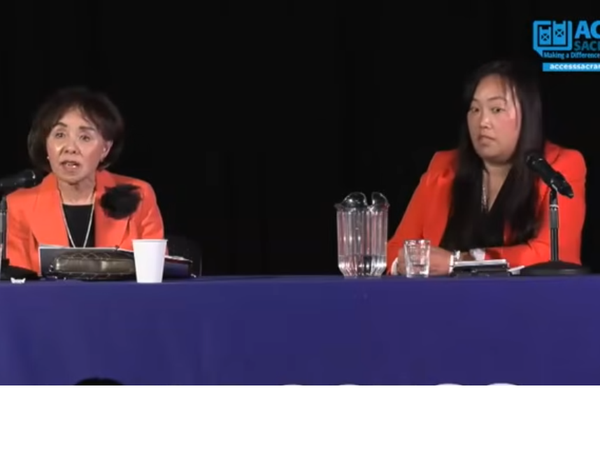
Mai Vang targets Doris Matsui over defense industry campaign contributions
In a fundraising email Thursday, Vang linked the contribution to the war in Iran
SACRAMENTO, Calif. — Congressional candidate Mai Vang is sharpening her criticism of Rep. Doris Matsui over campaign contributions from the defense industry, making corporate political money and U.S. military policy another dividing line in a race that could help measure the strength of the Democratic Party's progressive wing heading toward 2028.
Vang, a Sacramento City Council member challenging Matsui in California's 7th Congressional District, singled out a $5,000 contribution from Honeywell International's political action committee to Matsui's campaign dated March 31.
The contribution came six days after Honeywell Aerospace and the Pentagon announced a framework agreement aimed at increasing production of critical defense technology.
In a fundraising email Thursday, Vang linked the contribution to the war in Iran and accused defense contractors of profiting while American families face higher costs.
"While working families pay for this war, the defense contractors and weapons manufacturers are cashing in," Vang wrote. "And a lot of that money finds its way right back into the campaigns of the politicians who are supposed to hold them accountable."
Vang's email described Honeywell as signing a "$500 million contract to manufacture weapons of war." Honeywell and the Pentagon describe the arrangement differently.
Under the framework agreement announced March 25, Honeywell committed to a $500 million multiyear investment to expand its own manufacturing capacity for military navigation systems, missile maneuverability components and electronic warfare technology.
The distinction does not change the timing highlighted by Vang: The $5,000 Honeywell PAC contribution shown in her campaign email was recorded March 31 (see below).
Vang is using the contribution to reinforce a broader theme of her campaign — rejecting corporate political money and questioning military spending.
"I have never taken a dime from corporate PACs, defense contractors, or AIPAC, and I never will," Vang wrote. "Because every dollar we pour into endless war is a dollar stolen from the families I'm running to fight for."
That argument increasingly echoes themes being used by progressive Democratic candidates nationally, where opposition to corporate PAC money, defense spending and the influence of groups such as AIPAC has become part of a larger dispute over the party's direction.
The Matsui-Vang contest is particularly notable because the ideological fight survived the June primary and will continue through the November general election.
Vang finished first in the primary, ahead of Matsui, who has represented Sacramento in Congress since 2005. With both advancing to November under California's top-two system, voters will provide a relatively uncommon test of whether a progressive challenger can not only challenge an established Democratic incumbent in a primary but defeat one in a general election.
That question is playing out elsewhere.
In Michigan, progressive Abdul El-Sayed defeated establishment-backed U.S. Rep. Haley Stevens in this month's Democratic Senate primary despite heavy outside spending in the contest. His November race against Republican Mike Rogers will offer a different test: whether the progressive coalition that carried him through a Democratic primary can prevail in a competitive statewide general election.
Other Democratic contests this year have similarly exposed divisions involving corporate influence, health care, economic populism, Israel and U.S. military policy.
Those results could carry consequences beyond control of Congress.
With maneuvering for the 2028 presidential election already underway, Democratic candidates, donors and activists will be watching to see whether progressive candidates can translate primary enthusiasm into general-election victories.
A Vang victory over a longtime incumbent such as Matsui, particularly combined with progressive successes in states such as Michigan, could strengthen the argument that the party's progressive wing can compete beyond heavily Democratic primaries and deserves a larger voice in shaping the Democratic agenda.
A Matsui victory, or general-election defeats by prominent progressive candidates elsewhere, could strengthen the counterargument from establishment Democrats that progressive insurgencies do not necessarily translate into broader electoral success.
For California's 7th District, that makes what might otherwise be viewed as an intraparty Sacramento congressional contest part of a larger national experiment.
Voters will determine not only which Democrat represents the district, but potentially add another piece of evidence to an increasingly consequential question for the party: Who can win, and what kind of Democratic Party will enter the 2028 presidential election?