Elk Grove City Council 'accepts' aspirational staff recommendation to pursue Sac RT Light Rail
During their deliberations, the city council offered a mix of comments on the recommendation
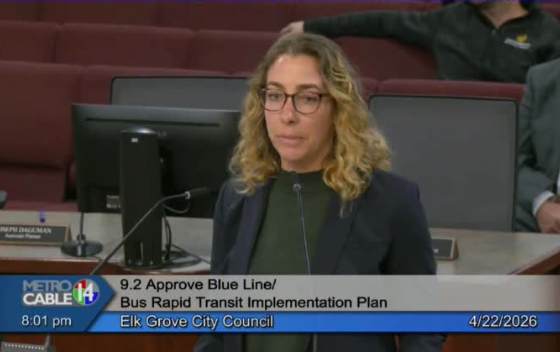
At last night's meeting, the Elk Grove City Council voted 4 - 0 to "accept" a staff recommendation and pursue the extension of Sacramento Regional Transit's Light Rail to service. Mayor Bobbie Singh-Allen skipped the meeting as she remained in Washington, D.C., following her and other city council members' participation in the Sacramento Metropolitan Chamber of Commerce's Cap to Cap junket.
The hearing, which lasted 1 hour and 15 minutes, included a staff presentation on other mass transit options, including bus rapid transit.
Elk Grove transportation planning manager Kaley Lyons told the City Council that a two-year study evaluating high-capacity transit options along the city's long-planned corridor found light rail offers the strongest long-term benefits despite higher costs.
The analysis compared multiple alternatives, including full light rail, bus rapid transit, and hybrid options, concluding that full light rail would deliver the fastest travel times, the highest ridership - projected to boost Blue Line use by about 20 percent - and better regional connectivity by eliminating transfers.
Lyons said community input also favored rail, noting that "70 percent of the survey respondents did select a build alternative…[and] light rail along the corridor was the most popular."
Staff recommended advancing a phased light rail project along the full corridor, beginning with initial segments as funding becomes available, while continuing planning, land-use alignment, and coordination for future federal, state, and local funding.
During public comment, eight people spoke in favor of the recommendation. Only one person was opposed.
Elk Grove resident David Baker urged council members to reject the proposed light rail project, arguing it would harm neighborhood character while offering little benefit. He said existing buses along the corridor are largely empty and warned rail would face the same issue, calling it "a solution that's like searching for a problem." See video below
Baker also cited high costs, over $1 billion, and potential tax increases, while suggesting road improvements and alternative transit options could better address congestion.
During their deliberations, the city council offered a mix of comments on the recommendation. The most critical were from Councilmember Kevin Spease.
Spease acknowledged that worsening traffic is partly due to community demand for more retail, dining, and development, which has increased congestion. While he agreed that the city needs a more efficient way to move people to Sacramento and the broader region, he expressed concern that current transit planning is too narrow.
Spease argued that focusing primarily on bus rapid transit (BRT) and light rail transit (LRT) overlooks emerging technologies that could better serve long-term needs. He emphasized the importance of planning for a 20-year horizon, warning against relying on outdated solutions.
"When the only tool you have is a hammer, you treat everything as a nail," he said.
In a detailed discussion over a proposed transit feasibility report, Elk Grove city officials focused heavily on the legal and practical distinction between "adopting" and "accepting" the document, an issue that shaped both the vote and its broader implications.
City staff emphasized that any council action would not authorize construction or commit funding, but merely acknowledge completion of a grant-funded study outlining potential transit options.
City Attorney Jonathan Hobbs said approval "does not commit the city to building anything" and instead "simply lays out a strategy we would continue to look at and explore options around."
Council members, however, expressed concern that the term "adopt" could signal a premature endorsement of a specific light rail alignment or implementation plan. Vice Mayor and others warned that such wording might mislead the public into believing a project decision had already been made.
To address this, the council agreed to amend the resolution, replacing "adopt" with "accept," reinforcing that the action was procedural rather than substantive. The change underscored that the plan remains conceptual, with significant analysis, including environmental review, regional connectivity, and evolving technologies, still required.
Ultimately, the council voted to accept the report while directing staff to continue the broader study, highlighting the project's long timeline and uncertain future.