Sport and commercial salmon fishing to open on California ocean waters this year, subject to quotas
According to official estimates, the current adult salmon population in California is 392,349, an improvement over recent years
San Francisco – California ocean waters will open to recreational and commercial salmon fishing this year, but are subject to a new quota season that halts fishing once the number of Chinook Salmon reaches a predetermined number to ensure that enough salmon return to the Sacramento, Klamath and coastal watersheds this coming fall.
The Pacific Fishery Management Council (PFMC) at its April 7 to 12 meeting ending Sunday in Portland, Oregon, finalized the sport and commercial fishing seasons in the ocean off the West Coast.
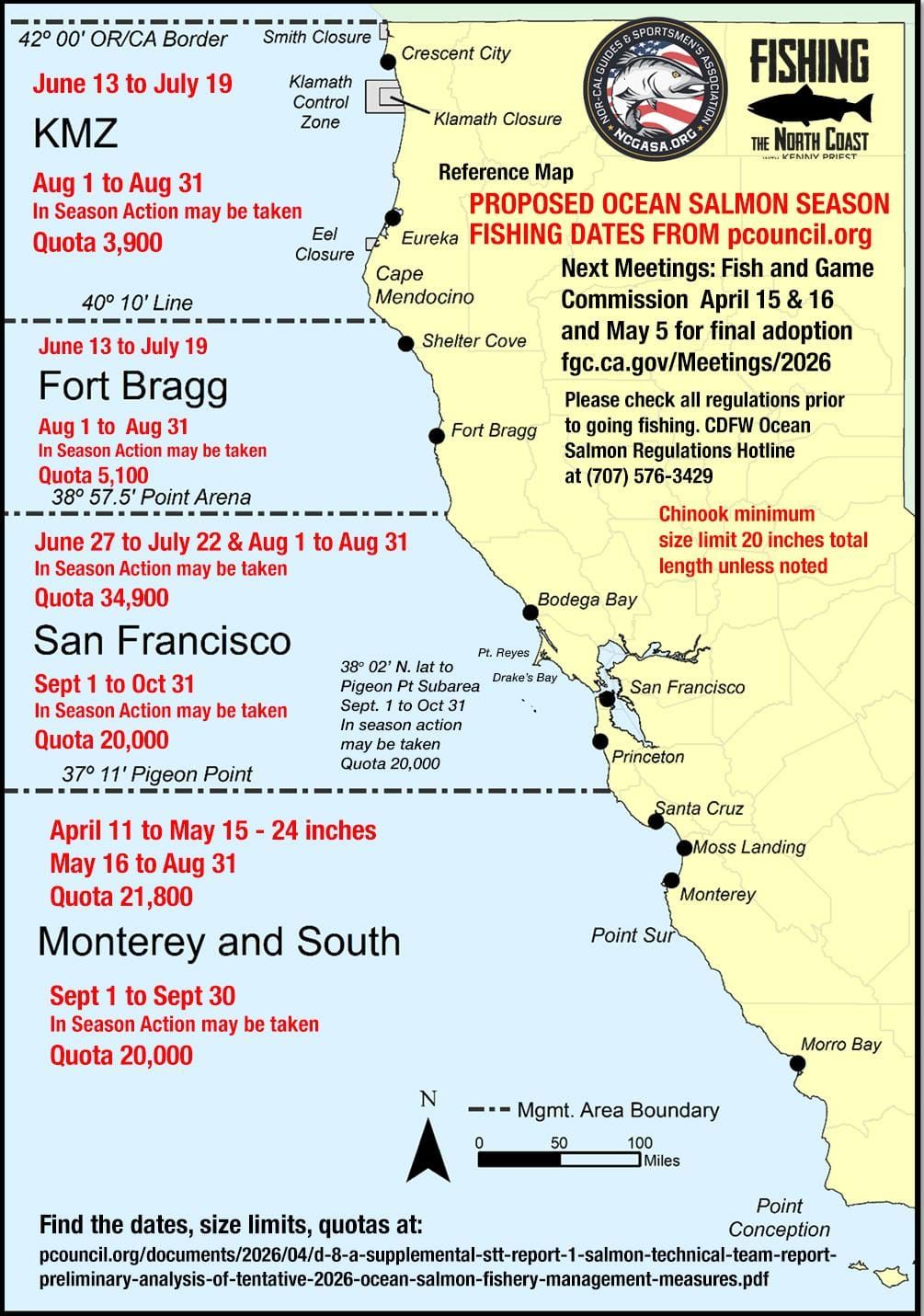
Recreational salmon fishing already opened on Saturday, April 11, from Pigeon Point south to the Mexican border, but the seasons in the rest of California were made official over the weekend.
The few anglers in boats that went out Saturday reported tough fishing conditions in Monterey Bay on the ocean opening weekend, due to windy weather. The summer quota is 21,800.
“I have heard of some anglers with 1-2 fish near Moss Landing,” said Todd Fraser at Bayside Marine in Santa Cruz on April 11. “However, the majority of the salmon were caught around Mulligan Hill. There were a few salmon caught at the tip of the Soquel Hole. “
“The water was not bad in the morning but it blew out by 10:00 am The south wind and the currents did not help the catch ratio,” Fraser noted.
The weather was worse on Sunday, with the few boats going out reporting no salmon catches.
Recreational fishing for salmon will begin north of Pigeon Point on June 27. This will include waters off Half Moon Bay, San Francisco, Bodega Bay, and up to Point Arena. The summer quota is 34,900 fish.
The waters in the Fort Bragg region, including Shelter Cove and Fort Bragg, will open on June 13. The summer quota is 5,100 Chinook salmon.
Waters in the Klamath Management Zone from the Oregon border south to the “40/10” line offshore of southern Humboldt County will open June 13. The summer quota is 3,900 fish. There are closures near the mouths of the Smith, Klamath and Eel Rivers.
“To implement the new quota system, each ocean regulatory ‘cell’ will be assigned a number of catchable salmon,” the Golden State Salmon Association explained in a statement. “Salmon that are caught will be counted in as near to real time as possible. When the number of fish caught in a cell equals the quota for that cell, fishing will be shut down.”
Commercial salmon fishing, for the first time in four years, will begin May 16. The summer season, which runs until August 27, will include five openings above Pigeon Point and ten below Pigeon Point. The openings last three to seven days.
Commercial boats will be limited to 160 salmon per opening and an overall quota of 83,000 salmon. Additional commercial fishing will be allowed in the fall season, starting September 4, until a quota of 20,000 salmon is caught, the GSSA noted.
“This year’s restrictions on the ocean fishery are aimed at protecting what is believed to be a low number of Chinook salmon born in coastal California rivers and streams between the Russian River in Sonoma County and Redwood Creek in Humboldt County,” GSSA stated. “These fish are protected under the federal Endangered Species Act. Because of these protective measures, salmon fishermen in the Sacramento River and its tributaries could see an improved in-river fishery this year.”
This year’s fishing comes after three years of a total fishery shutdown to commercial fishermen and the same to sport anglers, with the exception of six days of fishing allowed in 2025, GSSA said.
According to official estimates, the current adult salmon population in California is 392,349, an improvement over recent years, but still nowhere near historical numbers.
“We’re cautiously optimistic about what this year’s improved salmon seasons will bring,” said GSSA executive director Vance Staplin. “Businesses up and down the coast and inland are desperate for the economic boost this season will bring, especially after so many recent bad years of no business caused by the shutdown of salmon fishing.”
“Coastal communities that have grown to rely on the annual salmon fishery are excited at the prospect of hopefully becoming profitable again. When you calculate the economic multipliers, the salmon fishery can bring over a billion dollars, spread across not only California, but also in Oregon, where many Central Valley salmon migrate to rear in the ocean,” concluded Staplin.
“We’re excited to have a fishing season, even though it will be greatly restricted this year,” echoed GSSA board chairman Mike Aughney. “At the same time, we’re also concerned about the juvenile salmon currently trying to get out of the Central Valley and to the sea. After the extremely warm March, we can use all the rain we can get as baby salmon transit from fresh to saltwater between now and June.”
CDFW expresses optimism about salmon seasons
In an announcement on Sunday, the California Department of Fish and Wildlife (CDFW) confirmed this year’s more liberal but still restricted salmon seasons.
“Significant improvements in key California salmon populations -- specifically Sacramento River fall-run Chinook and Klamath River fall-run Chinook -- will allow for more ocean salmon fishing opportunities this year,” the agency wrote. “The California Department of Fish and Wildlife is pleased to announce that commercial ocean salmon fishing is back after being closed three straight years and that recreational ocean salmon anglers will have more opportunities in 2026.”
“Seeing our salmon populations recover is incredibly heartening and demonstrates what’s possible when we all work together – state and federal partners, tribes, sport anglers and commercial fishing interests, NGOs and others – to do what’s best for salmon,” said CDFW Director Meghan Hertel. “Salmon are part of the cultural fabric of California, and I’m delighted more Californians will have the opportunity to enjoy these magnificent fish whether that’s in the water, on the end of their fishing lines or on their dinner plates.”
The PFMC will forward its recommendations to the National Marine Fisheries Service (NMFS), which will implement them into federal regulations. A summary of the recreational season dates, locations and harvest guidelines will soon be available on CDFW’s Ocean Salmon Fishery Information web page.
“The health of our salmon populations fluctuates with environmental conditions, and we’ve seen just how vulnerable these fish are to recent droughts, changing river conditions and a warming climate,” said California Natural Resources Secretary Wade Crowfoot. “This year’s return of ocean salmon fishing is an encouraging sign as we advance California’s long-term, science-based Salmon Strategy.”
In 2026, CDFW said it will implement in-season management in both commercial and recreational fisheries to “ensure catch of rebounding salmon stocks does not exceed seasonal harvest guidelines.”
“This is the first year of vessel-based trip limits and seasonal harvest guidelines for California’s commercial salmon fishery following the first use of an in-season management framework during California’s limited recreational ocean season in 2025. In-season management allows fishery managers to close salmon seasons early should harvest guidelines be reached,” the agency stated.
In-season monitoring to actively manage commercial and recreational ocean salmon fisheries to align with harvest guidelines is identified as a priority action item in the California Salmon Strategy for a Hotter, Drier Future.
Sport anglers are advised to check for updated information when planning a salmon fishing trip. Season dates, harvest guidelines/catch limits, bag/possession, vessel limit information and gear restrictions can be found on CDFW’s Ocean Salmon Fishery Information web page as soon as it is available or by calling the CDFW Ocean Salmon Regulations Hotline at (707) 576-342
Public notification of any in-season change to conform state regulations to federal regulations is made through the NMFS ocean salmon hotline at (800) 662-9825.
Newsom opines on salmon seasons - as he moves forward with the salmon-killing Delta Tunnel, Sites Reservoir and Voluntary Agreements
Governor Gavin Newsom weighed on the salmon fishing seasons, stating, “Salmon aren’t just an important part of our ecosystem; they're part of who we are as Californians. They’re tied to our culture, our economy, and to generations of memories, including my own growing up, seeing these fish up close with my dad. That’s something every Californian should have the chance to experience.”
He concluded: “We’re seeing progress because of the work we’re doing together. We’re doubling down on our strategies to protect this iconic species and ensure it thrives, not just for today, but for generations to come.”
Unfortunately, any progress that has been made on the salmon restoration front is greatly overshadowed by Newsom’s relentless promotion of the Delta Tunnel, Sites Reservoir and the Big-Ag backed Voluntary Agreements, environmentally destructive fiascos that will lead to the extinction of Sacramento River winter, spring and fall-run Chinook salmon and Delta fish populations.
And if Newsom really wants to see progress in the restoration of native salmon populations, why has the California Department of Fish and Wildlife refused to keep funding the Winnemem Wintu Tribe’s unique program, in cooperation with state and federal authorities, that has brought the endangered winter-run Chinook back to their ancestral habitat on the McCloud River above Shasta Dam for the first time in 80 years?
“State officials say the one-time funds were tied to the state’s drought response and have now been used up,” according to Rachel Becker in CalMatters: calmatters.org/...
“The pilot was designed to take urgent action during severe drought conditions while testing key tools and approaches needed for potential long-term reintroduction,” California Department of Fish and Wildlife spokesperson Stephen Gonzalez told Becker in an email.
In response, Gary Mulcahy, government affairs representative for the Tribe, told Becker: “It makes me feel betrayed. It makes the tribe feel betrayed. It’s like they just gave up.”