Rural Roots Sunday - Last Call for Legends: The Three Bars That Built Old Elk Grove
Three places, the EG Club, the Y-Not Club, and Murphy’s Saloon, weren’t just spots to grab a drink. They were the living room of a rural town that knew exactly who it was.
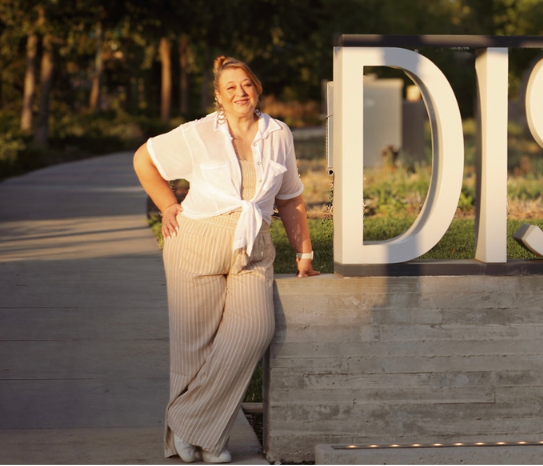
“…The Rural Area is valued in our community for its aesthetic and cultural significance, as well as the economic and educational opportunities that agriculture provides. Our commitment to maintaining the Rural Area is clear and codified in core planning documents…” Elk Grove General Plan, December 2025
Before the subdivisions, before the big-box stores, before Elk Grove became one of the fastest-growing cities in California, there was a stretch of road and a handful of barstools where the real fabric of this community was woven. Three places, the EG Club, the Y-Not Club, and Murphy’s Saloon, weren’t just spots to grab a drink. They were the living room of a rural town that knew exactly who it was.
Saloon culture was baked into Elk Grove from the start. Bob’s Club, built in 1876, was the only building left standing after the great fire of 1892, which makes it the oldest structure still in town. That stubborn refusal to be erased ran through the whole community, and it ran through these three bars.
Harold Dunbar built the EG Club into the kind of place that never had to advertise. Folks came for the prime rib, slow-roasted and carved to order, and stayed for the family-style soups and salads. As the old line goes, you would never go hungry after eating at the EG Club. Dunbar wasn’t running a corporate concept. He was a neighbor who knew what people wanted after a long day in the field, and he delivered it every night.
Fred Spiva ran the Y-Not Club out on Grant Line Road, right in the heart of the farming corridor. If the EG Club was the dinner table, the Y-Not was the back porch. The name itself was a philosophy. Why not one more round? Why not stay a while? Why not let the band play one more set? Ranchers, equipment operators, and country families made it their release valve, and that country spirit lives on out there to this day.
Lee Sievers held down Murphy’s Saloon, and the Murphy name runs deeper in this valley than any bar. The Murphy family settled along the Cosumnes River in the 1840s, and Murphy’s Corral was the site of the horse raid on June 10, 1846, that helped set California on the road to statehood. A saloon carrying that name was a living reference to the very ground it stood on.
And the stories. Gunfights. People meeting and marrying. Horses and motorcycles driven right through the front door. These aren’t dime novel fantasies. Rural Elk Grove ran on a frontier social code where celebrations were full contact affairs and the horse to human ratio in the parking lot was just different than in the city. There are families across this valley today whose grandparents met across a bar at the EG Club or caught each other’s eye during a set at the Y-Not. That’s not trivia. That’s the actual social infrastructure of a community doing its work.
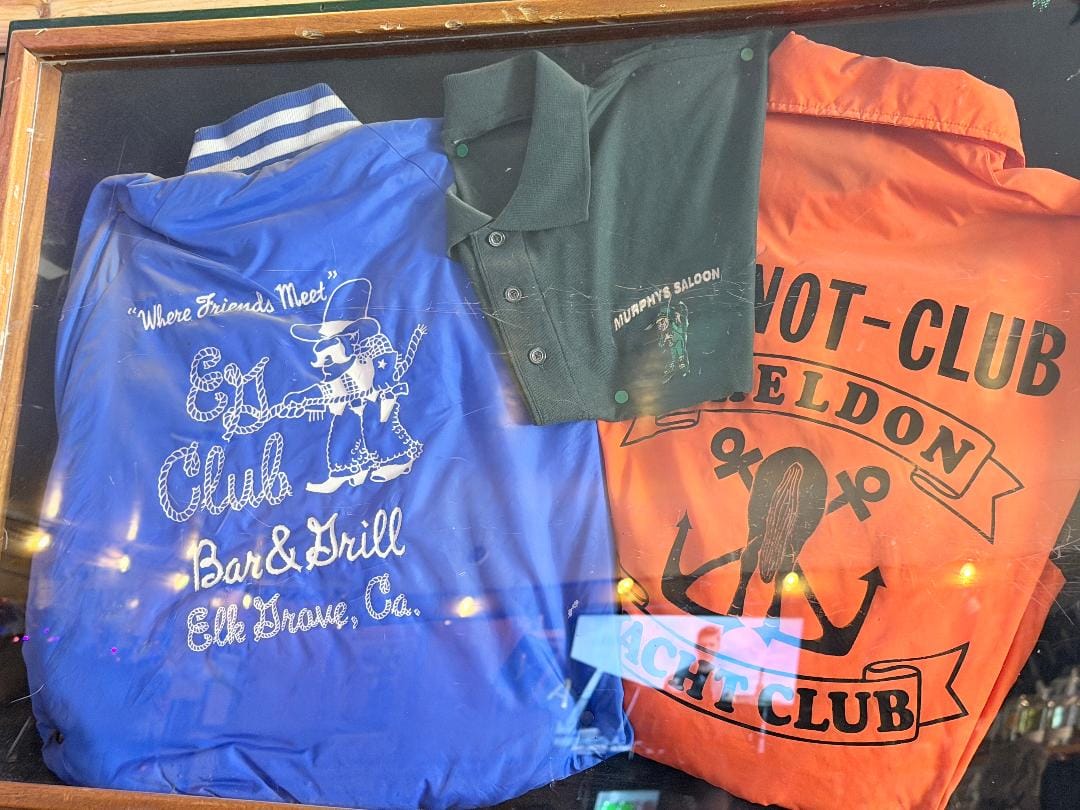
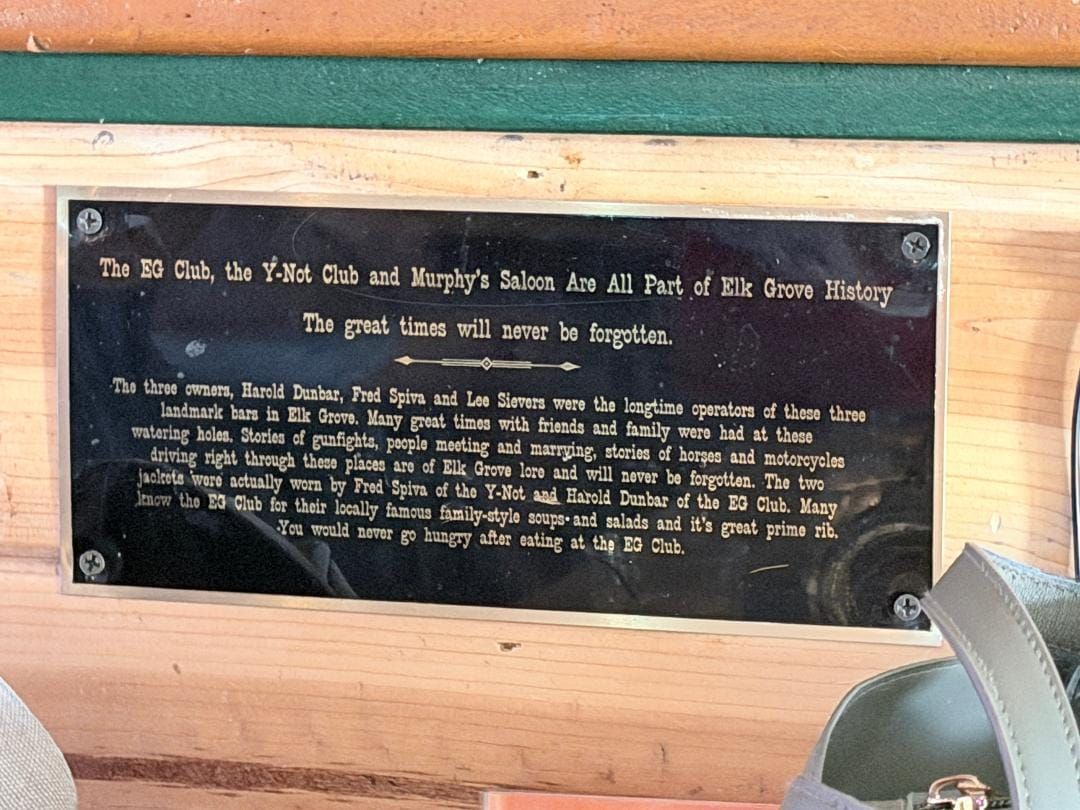
The two jackets, worn by Fred Spiva of the Y-Not and Harold Dunbar of the EG Club, are preserved now on a commemorative plaque. They weren’t just clothes. They were the uniforms of men who showed up every day and built something their neighbors depended on.
Elk Grove is a city of more than 175,000 people now, with chain restaurants and master planned communities and a civic identity that newcomers built from scratch. But underneath all of it is the Elk Grove that Harold Dunbar ladled soup in, that Fred Spiva kept the music going in, and that Lee Sievers held down at Murphy’s on a night when anything could happen and usually did.
The great times will never be forgotten. The plaque says so. And in a town where the oldest building still standing is a bar that survived a fire that burned everything else down, there’s every reason to believe it.
The photo of the plaque and clothing are in the Y-Not Club today as a reminder to anyone coming in to see and learn.
If you have a story, a photo, or a firsthand memory of the EG Club, the Y-Not, or Murphy’s, drop it in the comments. This history deserves to hear from the people who lived it.