Project Labor Agreement discussed at length during marathon EGUSD special meeting

A decision could be made as soon as next month on a project labor agreement for EGUSD
Share
Project Labor Agreement discussed at length during marathon EGUSD special meeting

The Elk Grove Unified School District Board of Education stopped short of approving a project labor agreement during their Tuesday, August 18 special meeting but directed district staff to continue developing one after a marathon session examining how such an agreement could affect future school construction.

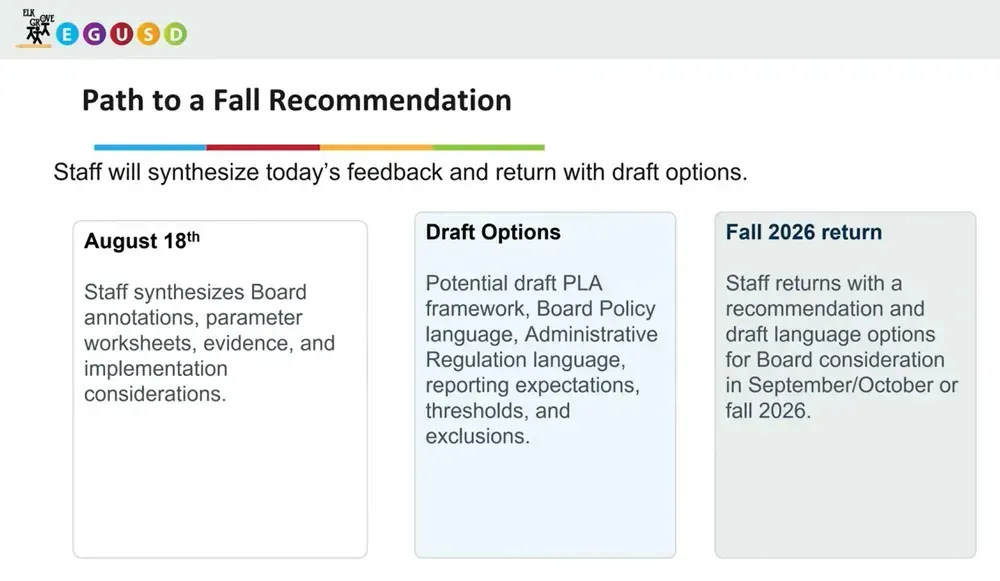
The meeting was structured as a workshop and study session rather than an action item. Staff made that distinction clear at the outset, saying, “No action is requested today,” and that the objective was to obtain enough direction from trustees to develop options for later consideration.

By the end of the meeting, a majority of trustees had indicated they wanted staff to continue working toward a potential project labor agreement, commonly known as a PLA. However, the board did not formally vote to adopt a PLA or authorize a final agreement.

A project labor agreement is a pre-hire collective bargaining agreement establishing labor terms and conditions for construction projects. Depending on how an agreement is negotiated, it can address such matters as wages and benefits, hiring procedures, apprenticeships, dispute resolution, labor stability and requirements that contractors and subcontractors follow the agreement while working on covered projects.

For EGUSD, the question could have significant financial implications. The district is preparing for hundreds of millions of dollars in construction funded partly through Measure N, the $542 million school bond approved by voters in 2024.

Staff told trustees the PLA discussion involves more than a choice between union and nonunion labor. The district identified six recurring issues: student opportunities, transparency and governance, construction costs and competition, use of local workers, alignment with district policy and labor opportunities.

Additionally, staff cautioned that advancing one objective could create trade-offs elsewhere, such as using a lower dollar threshold for projects covered by a PLA while potentially increasing administrative costs or reducing the number of bidders.

Staff's research of other school districts produced no clear-cut conclusion. One district reported reduced bidder participation, particularly for low-voltage work.

Cost effects appeared more pronounced on smaller projects, while staff found no clear cost impact on larger projects and no negative schedule impact reported by responding districts.

Another major focus was whether a PLA could create apprenticeships and construction career opportunities for EGUSD students.

Staff cautioned that an agreement alone cannot guarantee those results. If trustees want local hiring, apprenticeships and student career pathways to be measurable objectives, the district would have to establish definitions, geographic boundaries, data collection responsibilities and reporting requirements.

The debate was reflected in 19 public comments.

Rob Fong, speaking on behalf of Local 447 and in support of a PLA, urged trustees to consider the treatment of workers performing district construction. Fong argued that union contractors provide workers with fair pay, benefits and careers and said both union and nonunion contractors could seek district work under a PLA. He also argued that union construction provides access to a highly trained workforce.

“Please consider going with the project labor agreement with the building trades,” Fong told trustees.

Opponents focused heavily on competition and costs.

Eric Christen, executive director of the Coalition for Fair Employment in Construction, urged trustees to maintain the district's current open-competition approach. Christen pointed to EGUSD's record of completing 194 Measure M projects and questioned what problem the district was attempting to solve with a PLA. He cited experiences reported by other districts that he said showed reduced bidding competition and increased costs.

District staff's own contractor survey also raised concerns about bidder participation. Of 64 respondents, 29, or 45%, were union-affiliated and 35, or 55%, were nonunion. Staff said union-affiliated firms generally indicated they would continue bidding under a PLA, while many nonunion firms said they would be unlikely or unwilling to bid.

Trustees spent hours reviewing possible provisions, including which construction projects could fall under an agreement, dollar thresholds, exemptions for specialty work, local hiring, apprenticeship requirements, student career opportunities, contractor access and methods for measuring results.

The discussion eventually shifted from what a PLA might contain to whether trustees wanted staff to continue spending time developing one.

One trustee said support would depend on whether an eventual agreement created meaningful student apprenticeship and internship opportunities without jeopardizing district finances. Staff emphasized that trustees were not taking official action Tuesday but were being asked whether there was enough interest to continue developing the concept.

That distinction became particularly important near the meeting's conclusion.

Trustees sought clarification on whether their discussion amounted to approval of a PLA. Staff confirmed it did not.

Instead, a majority gave direction to continue working toward a potential agreement and develop its possible conditions. A formal decision would come later.

Staff had earlier indicated that, with sufficient board direction, it could return during the fall — potentially in September or October — with draft language, recommendations, possible thresholds, exclusions, reporting requirements and other safeguards.

For now, therefore, EGUSD does not have a newly approved project labor agreement as a result of Tuesday's meeting.

What it does have is direction from a majority of trustees to keep working toward one.

The ultimate decision — including exactly what projects would be covered, what protections would be included and whether trustees will approve a final PLA — remains for another meeting.