Could Republican voters help Mai Vang defeat Doris Matsui by not voting?
Any high-profile effort by Matsui to attract Republican voters by emphasizing her more moderate positions could create difficulties with progressive Democrats
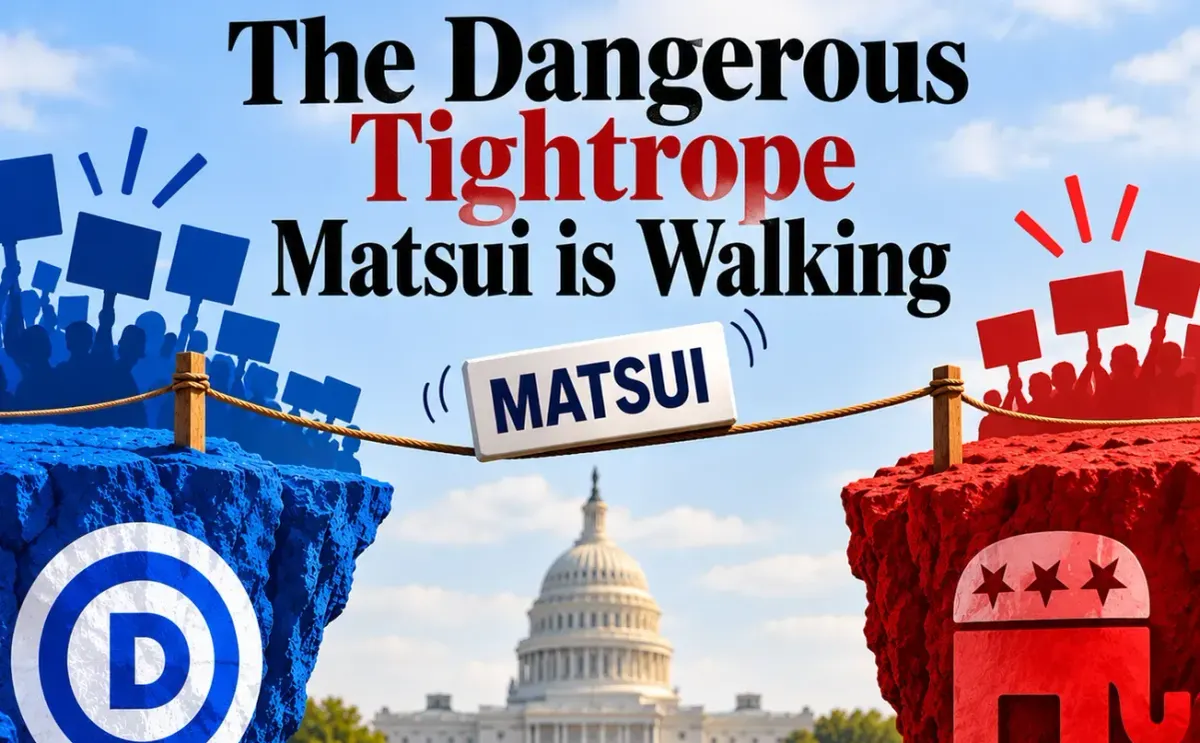
An analysis of California's elections suggests Republican voters who skip the 7th Congressional District contest could play a significant role in determining whether incumbent Rep. Doris Matsui or challenger Mai Vang wins the Nov. 3 election.
In an Oct. 11 analysis published in Capitol Weekly, political analyst Paul Mitchell examined what happens when California voters encounter two candidates from the same political party on their general election ballot.

Mitchell, whose team helped develop California's congressional district maps adopted through Proposition 50, found that voters frequently skip contests when neither candidate represents their political preferences.
That phenomenon, known as an "undervote," could have significant implications for the closely watched contest between Matsui and Vang, two Democrats representing different wings of their party.
Mitchell identifies three types of voters in these contests: those who select the candidate closest to their political views, those who cast protest votes against a disliked candidate, and those who simply decline to vote in that particular race.
His research found that in the 2022 and 2024 general elections, the median undervote in congressional contests featuring two candidates from the same party was 13.3%. By comparison, conventional Democrat-versus-Republican congressional contests experienced considerably lower undervote rates.
Mitchell's analysis also found that in selected legislative contests where opposing-party voters represented more than a quarter of the electorate, an estimated 41% of those voters skipped the race.
That figure represents historical voting behavior in selected contests, not a projection of Republican undervoting in the Matsui-Vang race.
Who benefits in CA-07?
Interpreting Mitchell's analysis, Matsui and Vang face different strategic considerations.
Matsui, the 10-term incumbent, would presumably benefit from Republican voters who consider her the more acceptable of the two Democrats.
Vang, a Sacramento City Council member challenging Matsui from the political left, could benefit from protest votes against the incumbent. More importantly, Mitchell's analysis suggests Vang could benefit from substantial Republican undervoting in the more conservative portions of the district added under Proposition 50.
That creates an interesting political paradox.
Republican voters who consider Vang too liberal might assume their best option is Matsui. However, Mitchell's historical findings suggest many voters confronted with two politically unacceptable choices simply leave the contest blank.
If that happens in significant numbers, Matsui could lose an opportunity to expand her support beyond Democratic voters.
For Vang, the potential benefit is straightforward. She would not necessarily need to persuade Republicans to support her. Instead, she could benefit if Republican voters who might otherwise support Matsui decline to vote in the congressional contest.
Under that scenario, Vang's chances would depend more heavily on her ability to mobilize Democratic and other supporters rather than winning over Republican voters.
The risks for Matsui
Mitchell's analysis also highlights a potential dilemma for Matsui.
An effort to attract Republican voters by emphasizing her more moderate positions could create difficulties with progressive Democrats, particularly those already sympathetic to Vang's campaign.
The challenge would be determining whether additional Republican votes would offset any loss of enthusiasm or support among Democratic voters.
Conversely, maintaining an appeal primarily directed toward Democrats could leave Matsui unable to capitalize on Republican voters who might prefer her over Vang.
Mitchell's research suggests that appealing to voters from the opposing party is not necessarily as straightforward as identifying the more moderate candidate.
His findings also leave open the possibility that Republican voters could cast protest votes for Vang, not because they agree with her political positions, but because they oppose Matsui.
A contest decided by those who abstain?
Mitchell does not predict which candidate will win CA-07 or how many Republican voters will skip the congressional contest.
His research nevertheless raises an important possibility: In a close election, the number of Republican voters who leave the race blank could be large enough to affect the outcome.
For Matsui, Republican participation in the congressional contest could provide an opportunity to expand her coalition.
For Vang, Republican abstention could reduce that advantage, allowing the contest to be decided more heavily by Democratic and other participating voters.
Ultimately, Mitchell's analysis suggests that the winner may depend not only on which candidate persuades more voters to support her, but also on how many voters decide that neither candidate deserves their vote.
In a contest between two Democrats, Republican voters could influence the outcome without casting a vote for either one.
Source: Paul Mitchell, “Is the Undervote going to be decisive in 2026?”, Capitol Weekly, Oct. 11, 2026.