New California water coalition releases 'Water Renaissance' vision for the state's water future that rules out the Delta Tunnel
Among other findings, the new plan identifies the opportunity to secure 1.8-2 million acre-feet of drought-proof water supplies in Southern California by 2045 through sustainable technologies
In an online press conference on May 20, conservation groups and Tribes unveiled a Water Renaissance Plan for California that rules out the salmon-killing Delta Conveyance Project, AKA Delta Tunnel, being pushed by the Gavin Newsom administration and California Department of Water Resources (DWR).
The testimony of DWR engineer Amardeep Singh last year revealed that the DCP will increase water deliveries from the Delta by 22% at a time when the estuary is in its biggest-ever ecological crisis. Moreover, during drought periods when fish are already strained by low flows and high temperatures, the Delta Tunnel would increase deliveries by 24%: static1.squarespace.com/…
In contrast with Newsom's proposal that aims to divert more water from a collapsing ecosystem at time we are seeing increasing climate disasters in California and elsewhere, "Water Renaissance Plan" lays out a vision, including specific goals and metrics, for prioritizing local water resilience in California's urban areas – especially in Southern California – to "support a pivot away from the state’s overreliance on unreliable imported water," as revealed in the conference.
The press conference featured moderator Ashley Overhouse, Defenders of Wildlife; Frankie Myers, Fix the World Consulting and Former Yurok Tribe Vice-Chair; Benjamin Bass, Ph.D., UCLA Center for Climate Science; Bruce Resznik, Los Angeles Waterkeeper; Barbara Barrigan Parrilla, Restore the Delta; and Barry Nelson, Golden State Salmon Association. A recording of the press conference is available for viewing here.
Frankie Myers began the press conference talking about the history of California water and where we are now, drawing from his many years of experience as an indigenous cultural practitioner on the Klamath River:
"Yurok legends tell us when the world was created the spirit people, the ones who came to create the world around us, created an environment out of balance, an ecosystem that was out of balance. The world was shifted
“It was the idea that when humans came to this place it was our responsibility and role to bring balance to the ecosystem, that we were supposed to be part of the world around us to help create habitat so that we could all thrive together, all of the species here on this planet. At some point we forgot that. Currently as a society for far too long we have completely disregarded our purpose and responsibility to the ecosystem around us.
"Pre-contact on this continent, we had ecosystems that were fully managed by humans, managed to create abundance for wildlife and for humans. And for thousands of years that system worked and flourished. Our society grew and our people were strong and we had abundance for generations.
"In an extremely short amount of time the abundance that this country once had was completely gobbled up, and used and destroyed. And the idea that humans are part of the world, that our responsibility is to create ecosystems in balance, was completely forgotten.
“I think it’s harder to find a better example of this practice than the California water policy of the last 100 years. California by policy and by law created an environment that extracted our native practices and moved our people away from their waterways, away from our homelands. And through water raids of the early 1900s completely disregarded tribes as sovereign governments, completely leaving tribes and POC outside of decisions, and not able to make good impacts on what the future of water in California would eventually look like.”
“I’m very excited today to be part of this fantastic panel to talk about the renaissance of water in California because it is taking traditional ecosystem knowledge to the forefront, it is looking at how we can become better stewards of the ecosystems that are around us. Regardless whether you are up here in Northern California on the Klamath River or the other part of the state in San Diego, you are a part of an ecosystem and you are responsible for it.”
“We have got to do a better job in the next 100 years than we did in the last 100 years if we truly want to create a place of abundance once again. Thank you so much for the opportunity to speak and to share a bit of what I have learned as an indigenous cultural practitioner growing up on the Klamath River. These lessons that we have learned and handed down from generation to generation throughout California are principles, principles on how to live in this place and live in abundance. It starts with taking responsibility in your own village. It starts with taking responsibility for the ecosystem that you live in.
“This idea that you can steal and share and divert water however you want with no consequences has got to end. We have to see a shift in our community, we have to see a shift in our society by taking our responsibility of being stewards of the environment seriously. We cannot send our children into debt for the next 100 years because we refused to take responsibility for our place and our time.”
Among other findings, the new plan identifies the opportunity to secure 1.8-2 million acre-feet of drought-proof water supplies in Southern California by 2045 through sustainable technologies including stormwater capture, wastewater recycling, conservation, and groundwater cleanup. The total cost for such investments would be approximately $44 billion.
In comparison, the proposed Delta Conveyance Project is only projected to yield 0.4 million acre-feet of water annually at a likely cost upwards of $60 billion, according to the coalition.
“Southern California water agencies are already turning toward projects that can provide reliable local water,” said Bruce Reznik, executive director of LA Waterkeeper. “These types of investments make our region more resilient. We should direct ratepayer and taxpayer dollars to securing water supplies that are available year in and year out, rain or shine.”
The release of the plan takes place at a critical time when California salmon and Delta fish populations have collapsed, due to the export of water south to corporate agribusiness and water agencies. Commercial salmon fishing on California ocean waters was closed for three years because of the collapse of the Sacramento River and Klamath River fall-run Chinook salmon populations - and was reopened this year under strict quotas.
"The Sacramento River has experienced in the last 20 years a 95 percent decline in wild spawning salmon, the salmon that are actually the backbone of salmon fishing. It’s the most important salmon river in California. That crash is because of excessive water diversions," Barry Nelson told Northern California Public Media: https://krcb.org/20260520101051/news-feed/coalition-proposes-alternate-plan-to-address-state-water-needs
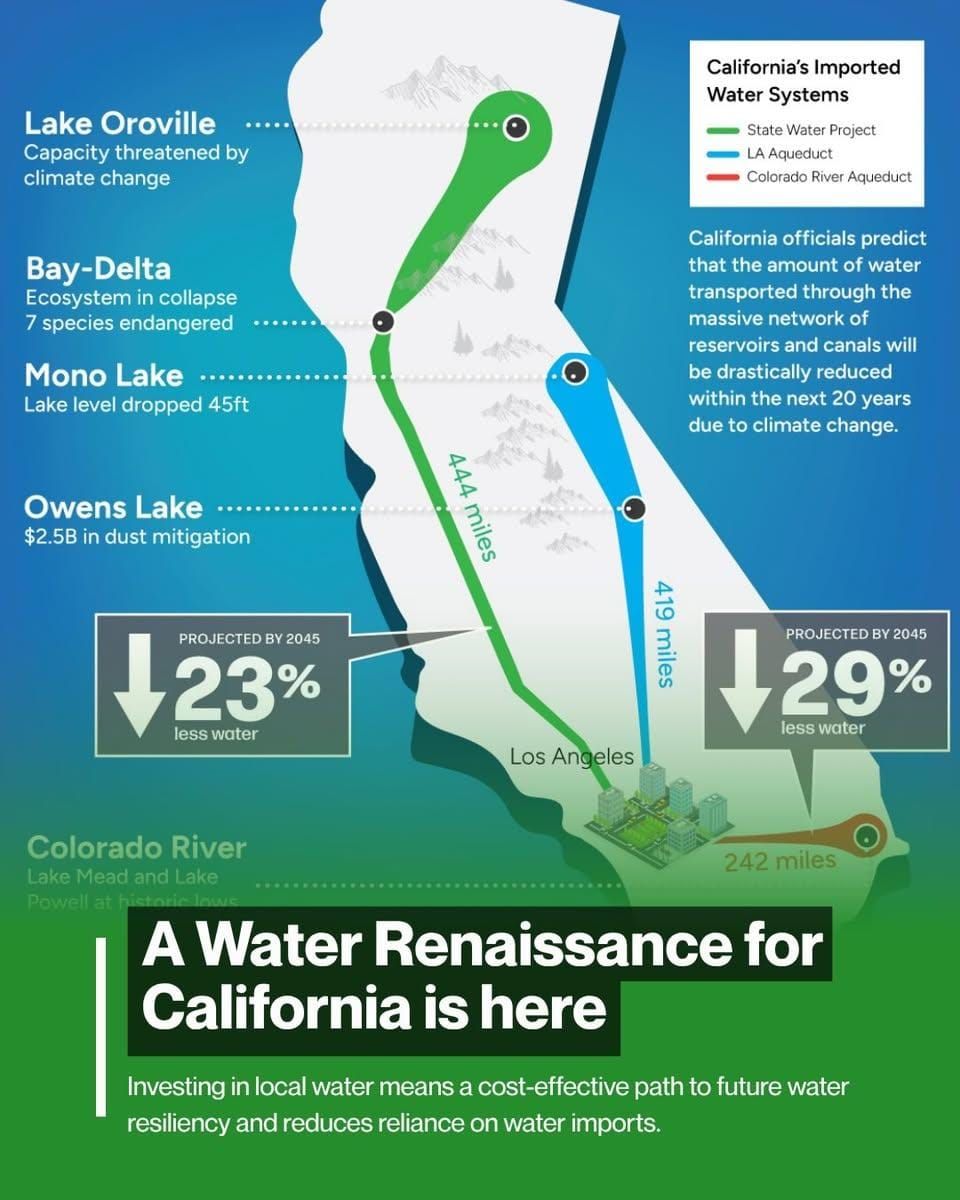
Meanwhile, the amount of water available for export from two of Southern California’s main sources of fresh water – the Bay-Delta and the Colorado River – is projected to drop by 23% and 29% respectively in the coming years, compared to available water in recent decades, as revealed in this fact sheet, The report argues that "continuing to over-invest in infrastructure designed to pipe water over hundreds of miles is a risky strategy, especially as snowpack and rainfall patterns become less predictable due to climate change."
"Water exporting regions are also feeling the strain of changing weather patterns. As has been widely reported, the Colorado River is at an all-time low since water exports began in the early 1900s. The Bay-Delta is on the verge of ecosystem collapse due to extensive water exports that support both Central Valley agriculture and urban uses in Southern California and Silicon Valley. In the Eastern Sierras, Mono Lake and Owens Lake are similarly struggling due to excessive exports to Los Angeles," the coalition reported.
“Proposed projects like the Delta Tunnel would decimate ecosystems and communities throughout California,” concluded Restore the Delta executive director Barbara Barrigan-Parilla. “It’s past time to focus our limited dollars on water infrastructure investments that are sustainable for both urban and rural farming communities, respect Tribal water and land uses, and will allow keystone species like salmon to recover. We can create improved water supplies and restore the largest estuary on the West Coast.”
The Water Renaissance Plan includes eight priority recommendations:
- Direct state agencies to end planning and advocacy for the Delta Tunnel and instead adopt and enforce science-based instream flow protections for the Bay-Delta and its Tributaries.
- Consider pursuing an ambitious general obligation water bond that focuses on modern local water supplies and does not include wasteful or environmentally damaging spending.
- Develop best management practices and regulatory standards to address harmful algal blooms.
- Require the adoption of tribal beneficial uses so that tribal uses are recognized and protected in permitting decisions.
- Direct state officials to ensure Colorado River diversions are appropriately reduced as part of a basin-wide plan to ensure long-term sustainability and protect the environment, tribes, and urban water users.
- Create a framework for local businesses to fund green infrastructure for stormwater capture.
- Remove the cap on large water recycling projects for receiving loans from the State Revolving Fund and allocate sufficient funds to the SRF to meaningfully support large-scale projects.
- Reform Proposition 218 to allow for local water rate assistance programs and ensure aggressive conservation rates can be implemented.
The Plan also includes analysis and sources to support its vision. It was drafted jointly by the California Sportfishing Protection Alliance, Defenders of Wildlife, Friends of the River,Golden State Salmon Association, LA Waterkeeper, Resource Renewal Institute, Restore the Delta, San Francisco Baykeeper, Sierra Club California, Winnemem Wintu Tribe, and Yosemite Rivers Alliance. As of May 19, 2026, 18 additional groups have endorsed the plan.
For a full list of endorsers and additional information about the Water Renaissance Plan, see www.cawaterrenaissance.org.