Analysis: Why Kevin Kiley's 2026 Survival Strategy Is Running Against California, Not Richard Pan
Front-runners rarely volunteer for unscripted exchanges, and incumbents with commanding advantages especially prefer ribbon cuttings, carefully staged town halls and controlled media appearance
Political campaigns have long been governed by a simple rule: when you're comfortably ahead, don't debate.
Front-runners rarely volunteer for unscripted exchanges, and incumbents with commanding advantages especially prefer ribbon cuttings, carefully staged town halls and controlled media appearances over the unpredictability of a debate stage. Why risk creating an unwanted headline when the election already appears to be moving in your direction?
That logic helps explain why many long-serving incumbents avoid candidate forums. But California's 6th Congressional District is no longer a normal incumbent race.
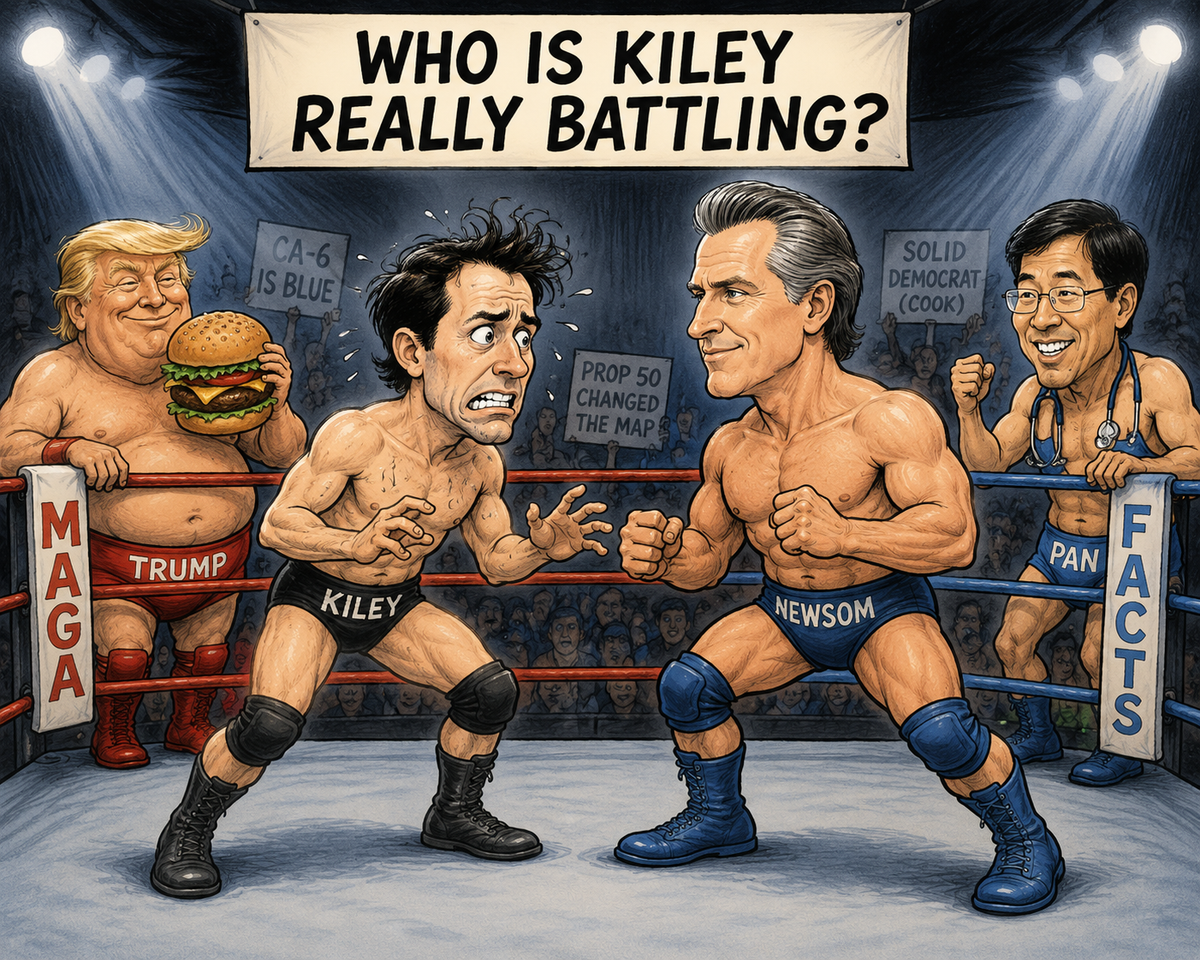
For Rep. Kevin Kiley, the political equation was rewritten the moment California's Proposition 50 dramatically redrew congressional boundaries. Instead of defending a district favorable to Republicans, Kiley suddenly found himself running for a deep blue congressional district by someone who is not a Democrat. The Cook Political Report now rates California's 6th Congressional District as "Solid D," its strongest rating for Democratic advantage.
When the fundamentals change that dramatically, campaign strategy must change with them.
Kiley's transformation over the past several months has been striking. The congressman who first won office in 2022 with Donald Trump's endorsement is now running as an independent while continuing to caucus with House Republicans. The move was a response to the new political geography created by Proposition 50.
Party registration, however, is only one part of the reinvention. Just as revealing is where Kiley has chosen to campaign.
Rather than limiting himself to conservative media outlets, he has become a frequent guest on CNN, MSNOW and NPR—networks many Republican officeholders either criticize or simply avoid. That appears less like an ideological shift than a recognition that a candidate trying to persuade Democratic and independent voters cannot remain inside the conservative media ecosystem.
Even more revealing is the target of Kiley's campaign.
His fundraising emails scarcely mention House Democratic leadership or even his Democratic opponent, Dr. Richard Pan. Instead, they devote most of their attention to California itself—Gov. Gavin Newsom, Attorney General Rob Bonta, state taxes, regulations, education policy and Sacramento's management of state government.
One recent campaign message spends nearly its entire length criticizing Newsom's gas vehicle policies, health care financing, state spending and education decisions before mentioning Pan only briefly near the end. Another announces Kiley's first debate with Pan, but quickly pivots back to attacks on Newsom's health care policies, ballot language, education decisions and other actions by state government.
Taken together, the emails reveal a campaign that is framing the election less as a choice between two congressional candidates than as a referendum on California's Democratic leadership.
There is a practical reason for that strategy.
Although Kiley now appears on the ballot as an independent, he continues to caucus with House Republicans. Every discussion of Congress therefore inevitably leads back to Republican leadership and, ultimately, Donald Trump. In a district the Cook Political Report considers safely Democratic, defending Trump's agenda would likely prove far more difficult than prosecuting a case against Sacramento.
By shifting the conversation toward California's affordability crisis, education policies, taxes and the performance of state government, Kiley is attempting to fight on terrain where he believes Democratic voters themselves may harbor frustrations. Whether those frustrations outweigh partisan loyalties is the central question of the campaign.
None of this guarantees success. Richard Pan begins the general election with significant structural advantages rooted in the district's partisan composition. Yet campaigns are often less about ideology than adaptation.
Had Proposition 50 never passed, Kiley would likely be running much the same campaign that first sent him to Congress. Instead, he is emphasizing his independent label, accepting debates early, appearing before audiences many Republicans avoid and spending far more time criticizing California's Democratic establishment than Washington Democrats.
That is not necessarily ideological conversion. It is political survival.
And in a district where nearly every structural indicator favors Democrats, it may also be the only practical strategy available.
The irony is difficult to ignore. Kevin Kiley, one of Donald Trump's earliest California congressional endorsees, now finds himself attempting to survive in a district reshaped by the nationwide redistricting battles that intensified after Trump urged Republican states to maximize their congressional advantage.
California's response was Proposition 50, producing a map that heavily favors Democrats and forcing Kiley into a campaign centered not on defending Trump, but on prosecuting the case against California itself.
Whether that strategy can overcome the district's overwhelming Democratic tilt remains uncertain. But if Kiley loses this November, it will not simply be because Richard Pan ran the stronger campaign.
It may also be because the map—not the message—ultimately proved decisive.