Is Rep. Kevin Kiley's Moderate Turn Genuine?

Is Kevin Kiley's more moderate tone evidence of a genuine evolution as a congressman?
Share
Is Rep. Kevin Kiley's Moderate Turn Genuine?

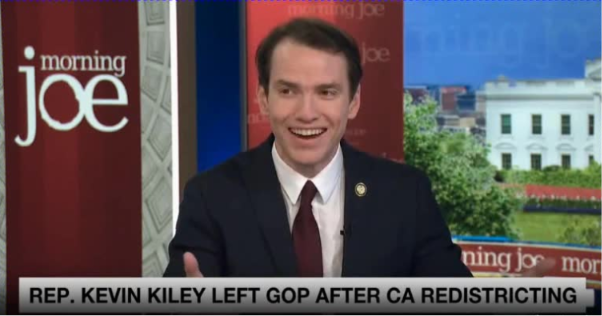
When Rep. Kevin Kiley appeared on yesterday's episode of KQED's Forum with host Mima Kim, he offered what may become the defining message of his 2026 reelection campaign.

On the subject of U.S. military involvement in Iran, Kiley attempted to occupy a middle ground. He criticized Congress for taking "a back seat" on war policy, said lawmakers should play a central role in decisions involving military action, and expressed frustration with what he described as an ad hoc strategy.

Yet he also voted against a War Powers Resolution that would have required President Donald Trump to seek congressional approval or withdraw U.S. forces.

When Kim asked why he voted against the resolution, Kiley argued that the measure was legally flawed, unlikely ever to become law, and potentially dangerous because it could require an immediate withdrawal of American personnel. Instead, he said Congress should exert its constitutional authority through the appropriations process by attaching conditions to future funding.

Whether one agrees with that reasoning or not, the exchange illustrated the political balancing act Kiley now finds himself performing. He criticized the administration's approach while rejecting the principal congressional vehicle designed to limit presidential war powers.

The result was a position that attempted to satisfy both constitutional conservatives who favor congressional oversight and Republican voters reluctant to constrain a Republican president.

That balancing act extends far beyond foreign policy.

The race between Kiley and former Democratic state Sen. Dr. Richard Pan in California's newly redrawn 6th Congressional District may become one of the state's more fascinating political tests. The central question is not simply whether Pan can defeat Kiley. It is whether voters believe Kiley's political repositioning represents a genuine evolution or an electoral necessity.

For most of his congressional career representing California's former 3rd Congressional District, Kiley was viewed as a reliable conservative Republican.

His initial election to Congress was backed by an endorsement from Donald Trump during a Republican primary against former Sacramento County Sheriff Scott Jones, himself a prominent Trump supporter. Throughout his tenure representing the old district, Kiley consistently supported much of Trump's legislative agenda, including voting for the controversial "One Big Beautiful Bill."

Then California voters approved Proposition 50.

The voter-approved proposition significantly altered the political landscape by reshaping congressional districts, leaving both the new 3rd and 6th Congressional Districts with Democratic registration advantages. For Kiley, the change transformed what had been a comfortably Republican district into one where appealing solely to the GOP base would almost certainly be insufficient for reelection.

Since then, observers have seen noticeable changes in Kiley's public outreach.

In recent months, he has appeared on CNN, MSNBC, NPR and, most recently, KQED, media outlets that conservative Republicans have often criticized and that many GOP officeholders avoid. Rather than using those appearances to deliver campaign-style partisan attacks, Kiley has frequently presented himself as thoughtful, measured and willing to criticize both parties when appropriate.

That approach makes political sense.

Competitive districts are rarely won by energizing only a candidate's most loyal supporters. They are won by persuading independents and moderate Democrats that a candidate is willing to govern pragmatically rather than ideologically.

The question is whether voters conclude that this represents an authentic change or simply an adjustment to new political realities.

Complicating that effort are Kiley's continuing communications with his political base.

As we previously reported, Kiley has continued sending campaign emails that question or cast doubt on vaccine policies, an issue that remains particularly sensitive in a district where his Democratic opponent is perhaps California's best-known physician-legislator and a longtime advocate of childhood immunization and public health policy.

That creates two distinctly different public images.

On television and public radio, Kiley often projects the image of a constitutional conservative interested in institutional checks and balances, congressional authority and pragmatic governance.

In campaign emails directed at supporters, he continues emphasizing issues that resonate strongly with conservative Republican voters, including skepticism toward vaccine policies.

Campaigns routinely tailor messages to different audiences. Every experienced politician does it to some degree. The challenge for Kiley is that today's political environment makes maintaining separate messages increasingly difficult. Television interviews, social media posts, campaign emails and legislative votes are all available to voters with a few clicks.

For Pan, the political argument almost writes itself. He can point to Trump's endorsement, Kiley's voting record, and his support for major Republican legislation as evidence that Kiley remains fundamentally the same conservative Republican who represented the old 3rd District.

Kiley, meanwhile, is likely to argue that his record demonstrates constitutional consistency rather than ideological rigidity and that his willingness to appear before audiences on CNN, MSNOW, NPR and KQED shows confidence in defending his positions before voters who may disagree with him.

Ultimately, the answer will not be determined by political commentators or campaign consultants. It will be decided by independent voters who now occupy the center of California's 6th Congressional District.

Those voters will likely ask three straightforward questions.

Is Kevin Kiley's more moderate tone evidence of a genuine evolution as a congressman?

Or is it simply the political adaptation required by a district that has become substantially more Democratic?

And if he wins another term, which version of Kevin Kiley will return to Washington—the independent-minded constitutional conservative seen in recent national interviews or the reliably pro-Trump Republican whose record was built in a much different congressional district?

Those questions may ultimately prove more important than any single television interview or campaign advertisement during the 2026 race.

Audio Interview

audio-thumbnail
Rep Kevin Kiley KQED Forum July 21 2026
0:00
/364.121995

Interview Transcript: Rep. Kevin Kiley Discusses Congressional Authority and the Iran Conflict

Mima Kim: Well, let's hear what a California member of the House thinks of all this. Joining me now is Representative Kevin Kiley, an independent who caucuses with Republicans. Congressman Kiley, thank you so much for joining us.

Rep. Kevin Kiley: Of course. Thanks for having me.

Mima Kim: President Trump informed Congress this month that the ceasefire was over, that the nation was again at war with Iran, starting another 60-day clock to deploy the military without congressional authorization. Is that okay with you, Congressman Kiley?

Rep. Kevin Kiley: It's certainly not what we want to see, and it's not okay with me that Congress continues to take a back seat when it comes to defining the objectives here and the way to bring this conflict to a close. I've said from the very beginning that Congress needs to be centrally involved. That would be the condition for a durable peace where we bring in the Gulf States and our allies as well. Yet we instead continue to have this sort of whiplash, this high-wire act, with everything done on an ad hoc basis without any real sense of what the strategy is.

Mima Kim: Congressman, you voted against the joint resolution that directed the president to seek congressional approval or withdraw the military from Iran. Why did you vote against that?

Rep. Kevin Kiley: Because that's not the right way for Congress to have a hand in what happens from here going forward. The issue with the War Powers Resolution is, number one, it's not something the president is ever going to sign. Even if Congress somehow overrode a veto, it's probably not something that would be enforceable in court. And even if it was, it's not a good idea because a War Powers Resolution says all of our personnel would have to exit the area immediately. That's the sort of thing that would put our service members and U.S. interests in the region at great risk.

That's not the right way for Congress to exercise its authority here. The right way is through the power of the purse, which is why I've insisted that any supplemental funding appropriation should include very clear directives from Congress about how the funds should be spent, the direction this conflict should take going forward, and the involvement of Congress going forward.

It doesn't look like that's going to happen with the measure that's up this week, which is very disappointing.

Mima Kim: So then will you vote against it?

Rep. Kevin Kiley: Sorry, say that again.

Mima Kim: Will you vote against it?

Rep. Kevin Kiley: I'm very unlikely to vote for it based on what we've seen. It's coming together for a vote tomorrow, and it doesn't meet the conditions that I set out for something I'd be able to support.

Mima Kim: Conditions such as?

Rep. Kevin Kiley: Such as giving Congress a greater say in the conduct of operations going forward, or at the very least establishing a budget framework that includes intensive congressional involvement and oversight of where the money has been spent so far, how money will be spent in the future, what the strategy is, what the objectives are, and what we're actually going to be doing on a forward-going basis to involve our allies and the Gulf States toward the objectives we all agree on, which are keeping the Strait of Hormuz open, winding down this conflict, and assuring that Iran doesn't develop nuclear capability.

Mima Kim: Are your Republican colleagues with you on this? Could you see enough of them voting against this so the administration's request for supplemental funding does not come to pass?

Rep. Kevin Kiley: I think there have been a number of people in various parts of the Republican conference who have expressed misgivings about the way this has been handled. I've heard it on the Senate side as well. Whether that ultimately manifests itself in people voting against it, we'll see. But I have heard a lot of concerns from a lot of folks.

Mima Kim: So, do you support this war? Do you support the U.S. war with Iran?

Rep. Kevin Kiley: Of course I don't want the war to continue. I think that's where the vast majority of the American people are as well. But I also want to make sure it ends in a way that doesn't lead to even greater threats to the United States, our allies, our service members, and Americans going forward.

I think it's very frustrating to many people the way we've had this whiplash, these temporary agreements that fall apart. We thought we had this framework in place, but we haven't really been given a good sense of why it fell apart. That's why I think we need to fundamentally change the way American policy in this area is conducted going forward in a way that isn't just this sort of ad hoc negotiation or alternating between negotiations and military strikes, but rather a clear, coherent strategy that Congress has a fundamental role in crafting.

Mima Kim: I know you need to leave us for votes, but what is your message to voters who are concerned about the economy and the death toll of a lasting conflict? As you've probably been hearing in this conversation and others, the negotiations are not going anywhere.

Rep. Kevin Kiley: My message to voters is that I absolutely understand your frustration. I share that frustration, and I think what voters should demand of those of us who are in elected office and who are in Congress is that we exercise Congress's Article I authority in a way that will actually help us achieve our objectives and bring this conflict to a close.

That's a different position from those who say the War Powers Resolution is the one and only solution here, because as we discussed, that won't really achieve what people say it will achieve. On the other hand, it's also a different position from those who are simply fine with the administration doing this on its own or with Congress merely providing appropriations without scrutiny.

What I'm saying is that the way Congress can be involved here has real teeth. Congressional involvement can genuinely affect the course of the conflict through the appropriations process and guide American involvement going forward.

Mima Kim: Congressman Kevin Kiley, representing California's 3rd Congressional District, which spans most of the California-Nevada border and parts of Yuba, El Dorado, and Sacramento counties. Congressman Kiley, appreciate you being with us.

Rep. Kevin Kiley: You bet. Thanks for having me.

Transcription by YouTube