Doris Matsui, Mai Vang Escalate California 7th Congressional District Fight Over Corporate Money and GOP Strategy
The increasingly aggressive exchanges come as early voting turnout in the district remains relatively low
With just over two weeks remaining before voting ends in California’s June 2 primary election, the campaign rhetoric in the race for the state’s 7th Congressional District escalated sharply Monday morning as Democratic incumbent Rep. Doris Matsui and challenger Mai Vang traded accusations over corporate money, super PAC support and Republican election strategy.
Matsui, who has represented the Sacramento-area district in Congress for 21 years, and Vang, a Sacramento City Councilmember, are competing in California’s top-two primary system, where the top two finishers advance to the November general election regardless of party affiliation.
In a Monday morning press release, Vang’s campaign accused Matsui of attempting to elevate a Republican candidate into the November election in order to avoid facing a stronger Democratic challenger. That candidate is Zachariah Wooden, who has received several endorsements including the Republican Party of Sacramento.
The Vang campaign alleged that Matsui’s campaign website included opposition research materials describing a Republican candidate as “the strongest Republican in the June 2 primary,” which Vang characterized as an effort to influence Republican-leaning voters.
“Doris Matsui is intentionally boosting a MAGA Republican who wants to flood our city with ICE agents,” Vang said in the statement.
The release further accused Matsui of preferring to face a Republican in November rather than “a Democrat who refuses corporate money.”
Vang’s campaign also linked the issue to immigration enforcement concerns, arguing that Sacramento-area mixed-status families are fearful of potential immigration raids.
Earlier Monday morning, the Matsui campaign issued its own statement criticizing Vang over campaign financing and outside political spending.
Roger Salazar, identified in the release as a strategist for Matsui’s re-election campaign, accused Vang of hypocrisy for portraying herself as a grassroots candidate while allegedly benefiting from super PAC spending and prior corporate political donations.
“While Mai Vang touts the purity of her campaign contributions, here’s the truth: she has taken tens of thousands of dollars from corporate PACs throughout her career — including from PG&E, casinos, and corporate developers,” Salazar said in the statement.
The Matsui campaign also alleged that Vang had benefited from “nearly $500,000 in super PAC spending” supporting her candidacy and attacking Matsui’s record.
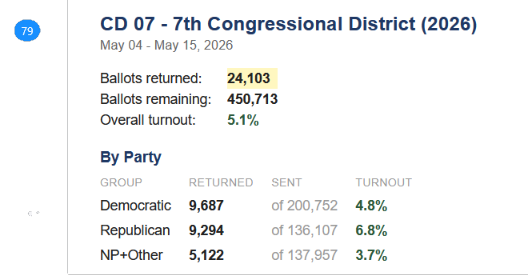
The increasingly aggressive exchanges come as early voting turnout in the district remains relatively low. According to Political Data Incorporated’s early vote tracker released Saturday, only 24,103 ballots had been returned in the 7th Congressional District between May 4 and May 15, representing turnout of 5.1 percent.
The PDI data showed Republican voters returning ballots at a faster pace than Democrats. Republicans had returned 9,294 ballots for a turnout rate of 6.8 percent, compared to Democrats, who had returned 9,687 ballots for a turnout rate of 4.8 percent.
Under California’s primary system, stronger Republican turnout could complicate the prospects for either Matsui or Vang if a Republican candidate consolidates enough support to secure one of the two November positions.
The data also showed turnout heavily skewed toward older voters. Voters aged 65 and older had returned 13,822 ballots for a turnout rate of 10.5 percent, while voters ages 18 to 34 had returned just 2,068 ballots, representing turnout of 1.7 percent.