Democrats Make Early Move in Key California Race — But It Could Backfire in November

Cook's Political Report rates the contest a toss-up
Share
Democrats Make Early Move in Key California Race — But It Could Backfire in November

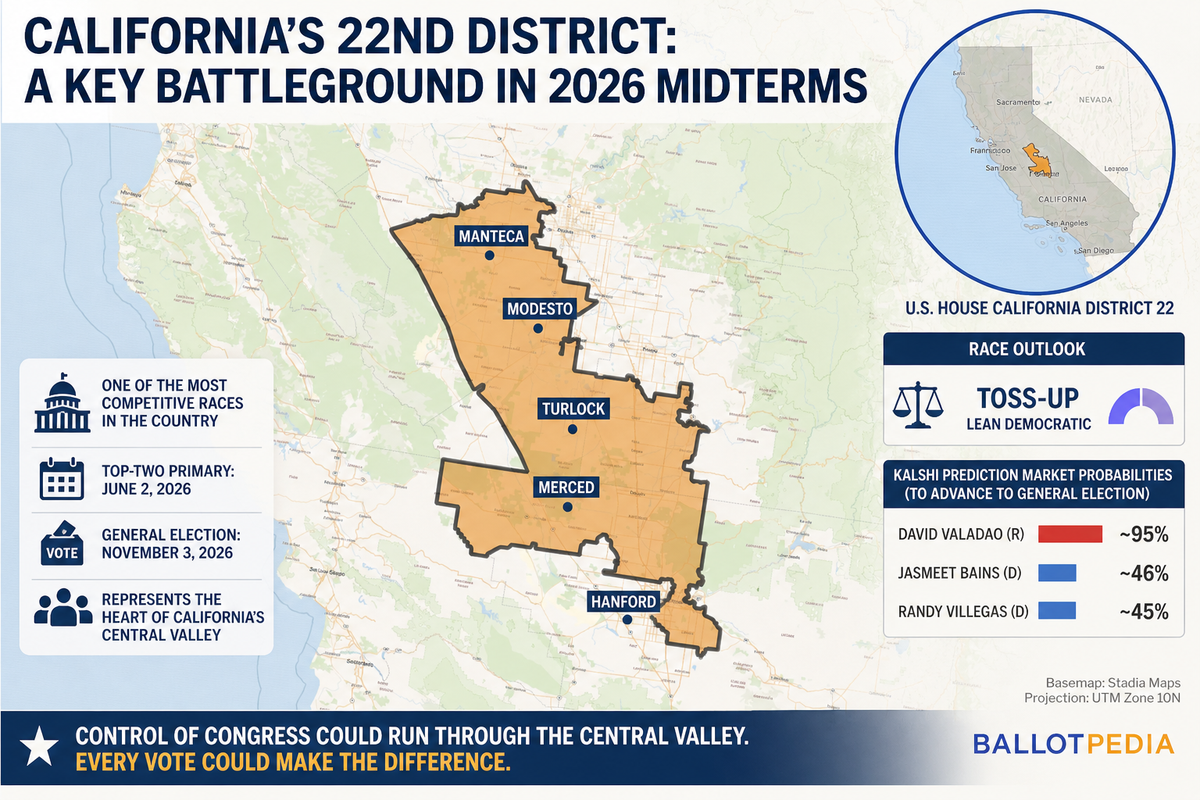
The battle for control of Congress in the 2026 midterm elections is expected to run through California’s Central Valley, where the 22nd Congressional District is emerging as a key battleground.

National Democrats signaled their strategy this week as the Democratic Congressional Campaign Committee endorsed California Assemblymember Jasmeet Bains in the closely watched primary race to challenge Republican incumbent David Valadao.

Bains, a second-term lawmaker, is competing with fellow Democrat Randy Villegas for a spot in California’s top-two primary system, where the leading two vote-getters advance to the November general election regardless of party. Valadao, the only Republican in the race, is widely expected to secure one of those positions.

In its endorsement, the DCCC highlighted Bains’ background in health care and contrasted it with Valadao’s voting record.

“Dr. Jasmeet Bains has fought on the frontlines of health crises and built a track record of delivering for the Central Valley,” the committee said. “Meanwhile, David Valadao has sided with Washington politicians to rip health care away from his constituents and proven he won’t stand up for working families.”

The early endorsement underscores establishment Democrats’ preference for Bains and signals that national party resources will likely flow into her campaign ahead of the June 2 primary.

But the move could carry political risk.

Progressive voters backing Villegas may view the endorsement as premature, potentially dampening enthusiasm if Bains advances to the general election. Party divisions in competitive races have historically raised concerns about turnout, particularly in districts where margins are expected to be narrow.

Political observers often point to the 2016 United States presidential election as an example of how intra-party fractures can affect general election outcomes, when some supporters of Sen. Bernie Sanders declined to back Democratic nominee Hillary Clinton.

Prediction markets and race outlook

With limited public polling available, political observers are increasingly looking to prediction markets for insight into the CA-22 race.

The Kalshi market currently gives Valadao a roughly 95 percent probability of advancing to the general election. Bains and Villegas, meanwhile, are in a near statistical tie, with both candidates hovering in the mid-40 percent range.

The race has tightened significantly in recent weeks. Earlier this year, Villegas held a commanding lead in prediction models, but that advantage has steadily eroded as Bains gained institutional support and momentum.

Independent analysts at the Cook Political Report changed the district's rating from “leans Republican” to “toss-up,” with a slight Democratic edge, reflecting both the district’s competitiveness and national interest in flipping the seat.

What’s at stake

If Bains secures a spot in the general election but fails to consolidate support from Villegas’ progressive base, Democrats’ chances of unseating Valadao could be weakened in one of the most critical races in the country.

With control of the House potentially hinging on a handful of districts, the outcome in California’s 22nd may ultimately depend not only on party strategy but on whether Democratic voters unite after a competitive primary.