Advocates urge CA officials to oppose Trump's 'Drill Baby Drill,' stop expediting oil permits
However, there is one big problem in increasing oil production in California - the oil reserves in California are rapidly being depleted
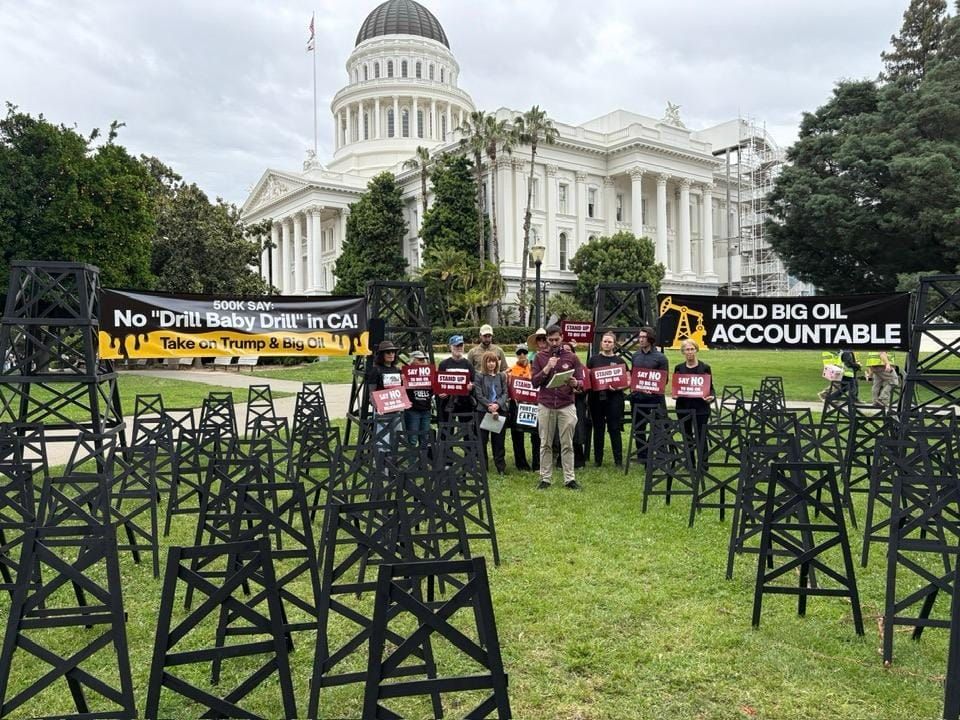
Climate leaders, environmental justice advocates and community leaders, including Third Act Sacramento members, convened on the State Capitol Lawn on April 20 to erect a dramatic “Capitol oil field” art installation with wooden oil derricks while urging Legislators and other State leaders to oppose the "Drill, Baby, Drill" mantra under Trump.
The 100 wooden "derricks" stood for the hundreds of new oil drilling permits approved by California oil and gas regulators in Kern County this year to date after a bill passed by the Legislature and signed by Governor Gavin Newsom facilitated the approval of up to 2,000 new permits per year.
On a day when the weather was alternately cool and warm, representatives of the Last Chance Alliance, FracTracker Alliance, the Center for Biological Diversity and NRDC spoke at a press conference surrounded by the "derricks." They pointed out the overwhelming opposition – nearly 500,000 comments submitted - to federal efforts to open the state’s public lands and coastal areas to increased fossil fuel extraction.
At the same time, they called state leaders to "reject pro-Big Oil policies in California and urge support for new bills that will protect the state’s coastline and hold the oil industry accountable for cleanup." Last year was the second largest year on record in lobbying expenses by Big Oil in California with a total of $32 million spent, led by Chevron and the Western States Petroleum Association.
Simultaneously, federal efforts are currently underway to open millions of acres of federal land and federal waters off the California Coast to oil drilling. Meanwhile, the Trump administration invoked the Defense Production Act to force the restart of Sable Offshore's badly corroded pipeline and its offshore drilling platforms that were shut down since the devastating Santa Barbara County oil spill at Refugio State Beach in 2015.
The advocates said new legislation offers "an opportunity for the state to change course." AB 2461 (Hart) strengthens bonding requirements for transferred oil wells. It was heard in the Assembly Natural Resources on Monday, April 20.
AB 1536 (Addis) increases protections for the state’s coast against federal pledges to expand drilling in federal waters off California, and was set to be heard in Assembly Emergency management today.
California gas prices are the overwhelmingly highest in the nation
Woody Little of the Last Chance Alliance opened up the presser with a quote from Governor Gavin Newsom.
‘Drill Baby Drill’ was always a lie to enrich Trump’s Big Oil donors — not a strategy to keep prices low, because oil is a global good with a global price," said Newsom.
"He’s exactly right," said Little. "Average gas prices in CA are nearly $6/gallon as Trump’s illegal war on Iran drives a global oil shock. Drillers are making a killing and early data suggests that California refiners are too,"
But Little said boosting state oil production "will do nothing to ease the pain at the pump. And trying to do so by sidestepping state law, public process and environmental review is even more dangerous."
"The good news is that key bills are up for committee votes this week to help chart the path forward towards accountability for Big Oil and protections for our communities," Little argued.
Little then pointed out the dire threat that Trump's plan to expand oil and gas drilling in California pose to the state's residents, wildlife and environment.
First, Trump’s Bureau of Land Management has over 1 million acres of California public lands and mineral rights in its crosshairs for new drilling and fracking
"Some of the most spectacular state and national parks, forests, and wildlife refuges are at risk. Under Trump’s plan, oil companies could target land around sites like Pinnacles and Mount Diablo among others," observed Little.
Second, Little said Trump’s proposed plans also flout California law. "We’ve banned fracking, and our trailblazing setback law enforces a 3200 ft buffer between oil drilling and communities," Little said. "But Bureau of Land Management (BLM) planning documents suggest the federal government intends to ignore these laws and put communities at risk by allowing drilling and fracking near homes, schools, and hospitals."
Third, Little noted that a separate Trump move threatens California’s coastline with the first new offshore drilling leases in federal waters (over 3 miles offshore) in decades.
Fourth, "Trump has also moved to stream roll state leaders and state law to restart a failed oil pipeline on the Santa Barbara coast that leaked catastrophically in 2015," he added.
"These drilling plans are the latest in the Trump Administration’s politically motivated, obsessive attacks on the safety and well-being of Californians, and seek to directly undermine California laws that protect the safety of our residents," Little said.
In challenging Trump, "state leaders have been in lockstep with the public. The governor, attorney general, and agency leaders are pushing back on these moves with just about every lever they’ve got," Little argued.
At the same time, just last year, "California paradoxically embraced what can only be called a Drill, Baby, Drill plan for Kern County, side-stepping environmental review for some of the dirtiest energy in the state and already permitting far more oil wells in the first months of 2026 than in the previous three years combined," he added.
California's oil industry enters its final stage
However, there is one big problem in increasing oil production in California - the oil reserves in California are rapidly being depleted.
"Whatever Trump and state leaders say or do, California’s oil industry is likely in its final stage," said Little. "Not because of state policy, but because oil reserves are nearly depleted. And without state action to make sure polluters pay for cleanup, over $20 billion in remediation costs are looming over state taxpayers."
Kyle Ferrar, Western Programs Director with the FracTracker Alliance, pointed out that "while our state leadership is taking a strong stance to defend our coasts, this good work is fortunately being done at the expense of sacrificing the health of our Central Valley neighbors in the South in Kern County."
He said Senate Bill 237, signed by Governor Newsom into law last September, split the state into two different regions. "The majority of the state continues to benefit from the environmental requirements of the California Environmental Quality Act, while Kern County is left to be a sacrifice zone to benefit oil industry profits," he said.
California issued hundreds of permits in Kern County beginning January 1
Ferrar revealed that as of last week, there have been 254 new oil drilling permits issued in Kern County this year. "That is more drilling permits that have been issued in the last 3 years combined," he noted. "We have not seen this many permits since 2020."
"Unfortunately, the new drilling in California will not reduce the price of gasoline. While gasoline profits are at all-time highs, state data shows that refineries are making record profits."
He added, "But we know, as the Governor shifts to the right, he is more and more in the wrong. From his lack of support of the people of Palestine to championing a law that creates a separate set of rules that sacrifice the health of California's most working class agricultural communities, the distinction between Sacramento and Mar-a-lago gets smaller and smaller."
"Let's get California on track to being a climate and environmental health leader and bring our Governor back to the core values of his supporters," he concluded.
Cleaning up all California defunct oil wells could top $21 billion
Ann Alexander, Principal of Devonshire Strategies, focused on the legislation addressing the question: "Who is going to pay for the cost of cleaning up defunct oil wells in California: is it going to be the companies who profited from those wells, or the public coffers?"
It’s a question with enormous implications for every taxpayer in California, she said. Current estimates are that the cost of cleaning up all of the wells in California after they stop producing tops $21 billion. And the bonds that oil companies have in place to pay for cleanup amount to a little shy of 1% of that amount.
"The problem is that as oil production declines in California – which it has been doing steadily for four decades as the wells start to run dry– there is less and less money in the system to pay for cleanup. Companies want out of the business, so they start selling their wells to others down the economic food chain, til someone goes bankrupt. It’s a big game of hot potato, and as things stand it’s you and me and all of us who are going to end up with the potato in our lap," she explained.
Back in 2023, the legislature took a big step to tackle this "hot potato problem" by passing AB 1167, the Orphan Well Prevention Act.
"What that bill requires is pretty simple and straightforward: if you buy a well, you have to show you have financial assurance in place to pay the actual cost of cleanup," she stated. "Equally simple is that the oil industry did not like this, and has been fighting it tooth and nail ever since. And that’s what this afternoon’s hearing is about."
First, she said the oil industry persuaded the regulator, CalGEM, to carve out a loophole in the Orphan Well Prevention Act. "And the oil well behemoth California Resources Corporation walked through that loophole and acquired 40,000 wells, and became the holder of nearly half the idle wells in California – all without adequate financial assurance for cleanup," she stated.
So the first bill, AB 2641 authored by Assemblymember Gregg Hart, will clarify that yes, the 2023 Orphan Well Prevention Act actually meant what it said about covering all oil well transfers, Alexander said.
"And second, since creating a loophole was apparently not enough, industry is now trying to functionally kill the Orphan Well Prevention Act altogether, by providing a weak substitute for compliance," she stated.
"So the environmental community is here to push back on the giant Ponzi scheme that is the commercial trade in oil wells right now. The oil companies are the ones responsible for the orphan well crisis we’re in now, and it should not be the public’s job to bail them out," Alexander concluded.
Background
I will update this story when I receive updates from the Legislative Hearings being held this week and in coming weeks.