Tribes, fishermen and environmentalists slam California's Big Ag-Backed Voluntary Water Agreements
Public trust advocates warn the plan prioritizes large agribusiness interests while undermining river health, Tribal Sovereignty, and fishing communities statewide.
Sacramento, CA — As fish populations in the Sacramento-San Joaquin River Delta continue to crash, a broad coalition of Californians said a resounding “No!” last week to a Newsom administration water plan they said would further exacerbate the ecological decline of the estuary.
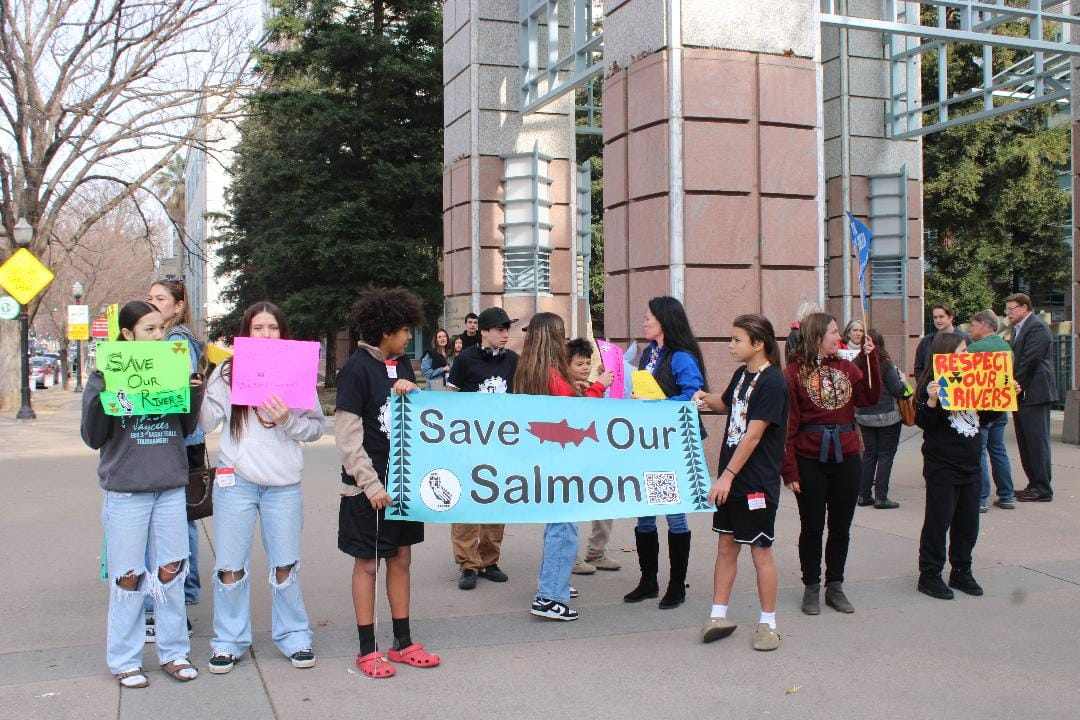
On Friday, Tribal members, fishing families, youth, and community allies hosted a rally and public comment opposing the Bay-Delta Plan and proposed Voluntary Water Agreements (VAs) at the California State Water Resources Control Board in Sacramento. Participants held colorful signs proclaiming “Save Our Salmon,” “Respect Our Rivers,” “Protect Our Rivers,” “Fish Need Cold Water,” and “55 to 65% Flows = Living Rivers.”
The rally and public comment took place during the final day of State Water Board hearings, marking the last opportunity for public input on a plan that would impact rivers, salmon, Delta fish species and drinking water across the state. It followed two days of powerful comments and panels opposing the plan by Tribes, Bay-Delta residents, environmental groups, and fishermen, according to a statement from Save California Salmon.
Opposition to the Voluntary Agreements has mushroomed as new federal actions by the Trump administration threaten additional water exports from the Delta — at a time when already massive water diversions have spurred the dramatic decline of salmon and Delta fish populations.
Gary Mulcahy, Government Liaison of the Winnemem Wintu Tribe, warned, “The clueless SWRCB continues to advocate for an 8-year experiment that fails to meet water, environmental, and aquatic species needs on so many levels as the VAs currently stand. And, now with the Trump administration’s ROD on Action 5 promising water deliveries of an additional 130,000 to 180,000 acre feet out of the Delta, the VAs can no longer be considered even partially viable.”
If adopted, the Bay-Delta Plan and VAs would reshape water management across nearly every watershed feeding the Bay-Delta, including the Sacramento, Feather, American, Yuba, Trinity, and Klamath Rivers. “This would threaten drinking water supplies and recreation for tens of millions of Californians,” the group noted.
Public trust advocates warn the plan prioritizes large agribusiness interests while undermining river health, Tribal Sovereignty, and fishing communities statewide.
“Replacing water quality protections with Voluntary Agreements puts the needs of corporations and agriculture above drinking water protections, communities, and rivers,” said Regina Chichizola, Executive Director of Save California Salmon. “The VA pathway ignores years of Tribal, scientific, and public input and sets a dangerous precedent that voluntary compliance can replace California's pollution laws.”
It is no surprise that Newsom is pushing these agreements when you consider that his biggest campaign donors include Big Ag billionaire oligarchs like Linda and Stewart Resnick, the owners of the Wonderful Company, as I have documented in article after article: www.counterpunch.org/...
On Friday, Delta Tribes testified they were shut out of the process, despite being seriously impacted.
“For Wilton Rancheria, Delta conditions directly affect cultural practices, subsistence activities, and stewardship responsibilities,” said Vince LaPena from the Wilton Rancheria. “Salmon and other aquatic species are not merely ecological indicators; they are integral to the Tribe’s cultural identity, traditional knowledge systems, food sovereignty, and responsibilities to future generations.”
Other Tribes testified they were not consulted or included in the VA process, despite having critical connections with, and rights to, the waters impacted.
Fishing groups, including both commercial and recreational fishermen, also urged the board to choose regulation instead of Voluntary Agreements.
Vance Staplin, Executive Director of the Golden State Salmon Association (GSSA), emphasized, “Water diversions are devastating California’s largest salmon runs, shutting down commercial fishing for three years and causing serious hardship for fishing families, businesses, and communities.”
He then called on the State Water Board to act, stating that “the State Board has the sole authority to restore these salmon runs and must reject Governor Newsom’s backroom water deal, listen to the facts, and require the river flows salmon need to survive.”
Morning Star Gali, Pit River Tribal member and Executive Director of Indigenous Justice, warned that the VAs deepen long-standing harm to Tribal communities.
“After decades of fighting for clean rivers, salmon restoration, and the remediation of toxic mercury contamination, Tribal peoples are once again being forced to carry the burden of protecting our waterways for current and future generations,” Gali said. “The VA’s role in privatizing water, prioritizing corporate profit over people, must be directly addressed. We are at a critical moment, and we must act now to stop this harm.”
Frankie Myers, a Yurok Tribal member and Principal of Fix the World Consulting, reflected on the California water system’s exclusion of Tribes.
“For generations, California built its water system by excluding Tribal Nations—treating our rights as invisible while benefiting from our rivers, our lands, and our stewardship. The Bay-Delta Plan cannot move forward honestly without confronting that legacy. Reconciliation is not symbolic; it requires the State to acknowledge its history of injustice and take meaningful action to correct a system that has long denied Tribes a rightful seat at the table,” Myers pointed out.
“Now is the time to reconcile that history and build a water governance framework that recognizes Tribal water rights as fundamental to California's future, not optional!” Myers said.
Youth and Tribal community members say this overwhelming opposition to Newsom’s a defining moment.
Onjalee Harrison, a Karuk Tribal youth and 8th-grade student traveling to Sacramento, stated, “Without enough water, our fishing traditions and ceremonies like Boat Dances are at risk. As Native people, it is our responsibility to protect the fish, the river, and our future, which is why I oppose Voluntary Agreements that would dramatically impact my life and so many others.”
Molly Colton, Sierra Club California Organizing Manager, also testified in opposition to the Voluntary Agreements at the hearing and the rally.
“Our core request is straightforward and urgent: the Board must adopt a science-backed, enforceable regulatory pathway that does not rely on Voluntary Agreements and that guarantees unimpaired flows of 55 percent or more in the Sacramento River and its tributaries.This must be the minimum unimpaired flow threshold, no matter the precipitation level and dryness of the water year,” Colton argued.
“Anything less is inconsistent with the Board’s constitutional obligations under the Public Trust Doctrine to protect fisheries and navigable waters, its statutory mandate under the Porter-Cologne Act to prevent unreasonable degradation of water quality, and its duty under the Clean Water Act to ensure that water quality standards are sufficient to protect designated beneficial uses such as cold freshwater habitat, migration corridors, and spawning habitat,” Colton concluded.
C-WIN: Plan protects the wealthy and powerful
The California Water Impact Network (C-WIN) also submitted comments on the State Water Board’s proposed updates to the Bay-Delta Water Quality Control Plan (WQCP). Their verdict: “the plan protects the wealthy and powerful and sacrifices the ecosystem.”
The plan is built around proposed “voluntary agreements” that would allow water contractors to “voluntarily” provide water in some years instead of meeting enforceable requirements to provide enough fresh water to improve beleaguered fish populations. Max Gomberg, senior policy advisor and board member for the California Water Impact Network, characterized it as a classic case of regulatory capture — the capture of the regulators by the regulated.
“The VAs are characterized by both legal and moral deficits,” stated Gomberg. “They raise the issue of whose voice counts for the purpose of settlement agreements. The settlements reflected in the VAs were reached by water districts and the state and federal agencies that manage the major water storage and delivery infrastructure. Tribes, environmental and fishery advocates, and local governments are not party to the VAs, and their interests were not included in the settlements.”
C-WIN’s comments also address other deficiencies and inequities in the draft WQCP, including:
• Disregard for the public trust doctrine
• Unsubstantiated claims regarding the plan’s “reasonable” approach to fish and wildlife protection
• The Board’s general abdication of its duties as a regulatory body and independent authority
Last week when the Water Board held three days of workshops to receive public comment on the draft WQCP, “An overwhelming majority of people spoke in opposition to the VAs, yet the Board Members indicated they believe the VAs are the only way to get more water into the Delta without disruption to existing water rights and contracts,” noted Gomberg.
Record-Breaking Public Opposition Marks Bay-Delta Plan Hearings
Then today, the Delta Tribal Environmental Coalition (DTEC), consisting of the Shingle Springs Band of Miwok Indians, Winnemem Wintu Tribe, Little Manila Rising, and Restore the Delta, announced that they had formally filed public comments in response to the State Water Resources Control Board’s proposed update to the Bay-Delta Plan, following of what they describe as “an unprecedented level of public participation” opposing the draft update.
“Delta communities and Californians more broadly do not support the flawed voluntary agreements proposal,” said Cintia Cortez, Policy Program Manager at Restore the Delta. “Deteriorating conditions are threatening the safety, health, and economic prosperity of Delta communities, cultural wellness of Delta tribes, and water supply for all Californians. We urge the Board to side with the community, who were the vast majority of respondents in recent hearings, and science in opposing the fatally flawed proposal.”
Cortez said the historic turnout reflects “extensive community organizing” led by a broad coalition of Tribes, conservation advocates, fishing groups, and environmental justice organizations, including: the Shingle Springs Band of Miwok Indians, Winnemum Wintu, California Indian Environmental Alliance, Sierra Club California, Yosemite River Alliance, San Francisco Bay-Keeper, Friends of the River, Defenders of Wildlife, California Sportfishing Protection Alliance, Restore the Delta and Save California Salmon.
“The comments submitted by DTEC reflect the clear and overwhelming opposition of everyday Californians and urge the State Water Board to reject the Voluntary Agreements approach. Instead, DTEC calls on the Board to enforce strong, science-based protections for Delta water quality and ecosystems, uphold democratic participation in water planning, and respect Tribal sovereignty and Traditional Ecological Knowledge,” the group concluded.
Read the Coalition’s comments in full here.
The Delta: an ecosystem in unprecedented collapse
The massive opposition to the Voluntary Agreements takes place as the Sacramento-San Joaquin River Delta suffers from its worst-ever ecological crisis — the result of already massive water exports from the largest estuary on the West Coast, combined with the impacts of toxics, pollution, reduced river flows and invasive species.
The latest California Department of Fish and Wildlife Midwater Trawl survey on the Delta reveals that zero Delta Smelt, an indicator species that once was the most abundant fish in the entire estuary, were found in the estuary for the eighth year in a row.
In addition, the populations of pelagic (open water) Delta fish species, including Longfin Smelt, Sacramento Splittail, Threadfin Shad and Striped Bass, have crashed to record low numbers in recent years: https://nrm.dfg.ca.gov/FileHandler.ashx?DocumentId=239888&inlin
Commercial salmon fishing off the California coast has been closed for three years, due to the collapse of the Sacramento and Klamath River fall-run Chinook salmon populations. While the salmon populations on both the Sacramento and Klamath watersheds appear to be improving, due to three wet years on both rivers and dam removal on the Klamath, the fish are still well below historical numbers.
And both the Newsom and Trump administrations appear to be doing everything they can to make things even worse by overseeing the diversion of even more water from the Delta!