Rural Roots Sunday: Just a Hop Field

Things survive out here that cannot survive anywhere else, and you do not always find out what they were for until later.
Share
Rural Roots Sunday: Just a Hop Field

“…The Rural Area is valued in our community for its aesthetic and cultural significance, as well as the economic and educational opportunities that agriculture provides. Our commitment to maintaining the Rural Area is clear and codified in core planning documents…” Elk Grove General Plan, December 2025

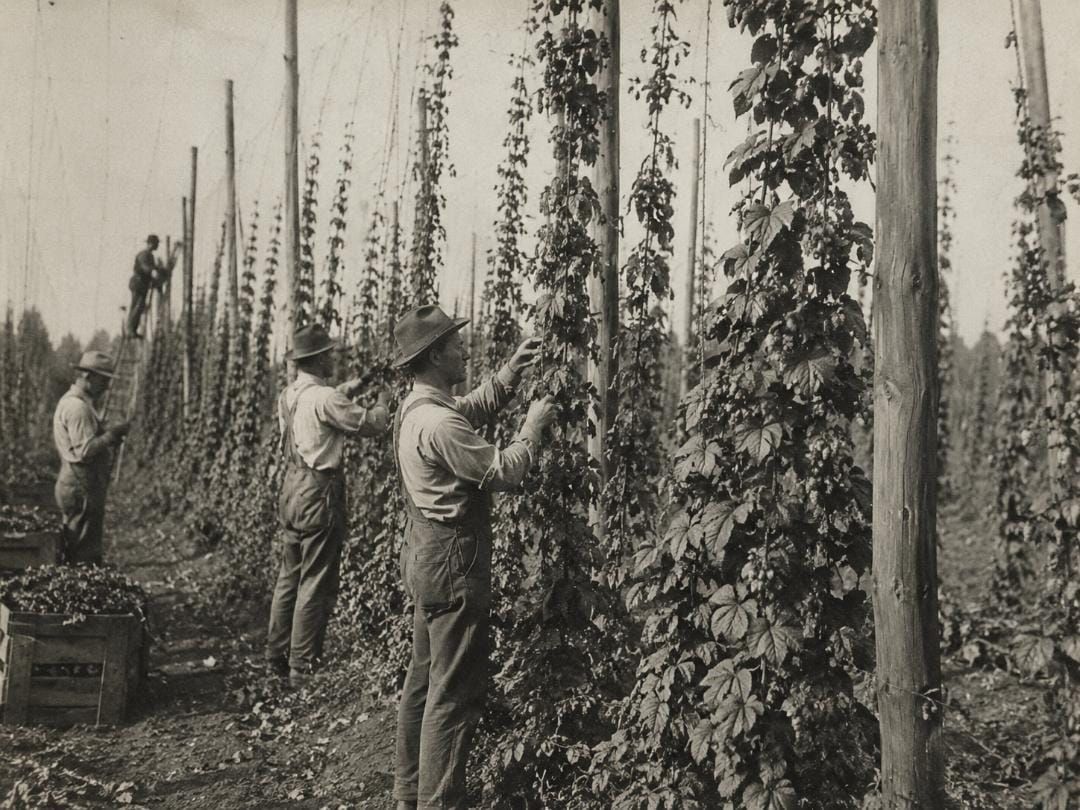
If you drive Jackson Road out past Sloughhouse, you are driving through what used to be hop country. Not a little of it either. In 1910, California grew over eight thousand acres of hops worth about 1.6 million dollars, and for most of the early twentieth century this state led the entire country in growing them.

Hops are a vine crop. They climb trellises fifteen or twenty feet up, and come harvest they had to be picked by hand. That meant people, a lot of them. Pickers came out from Sacramento and San Francisco and camped here for weeks at a time. There were carnivals. There were water fights. For a few weeks every year this quiet stretch of country turned into something closer to a fairground.

 Around 1930 a man named Avelino Signorotti started growing hops out here on Jackson Road. The timing was deliberate. Prohibition was on its way out, repealed in 1933, and he was betting that the country was about to want beer again. He was right.

 His son George took it over. George Signorotti was born in 1924 and spent his life in it. He was president of the Sacramento County Farm Bureau. He was president of United Hop Growers of California. He was president of Hop Growers of America twice. He was the first American ever elected president of the International Hop Growers Congress. A man from Sloughhouse ran the world’s hop growers organization.

 And then it ended. One by one, the California hop yards went under, unable to compete with the Pacific Northwest. The Signorotti Ranch was the last one standing in the entire state, and in 1985 it stopped producing too. That was it. The end of commercial hop farming in California, and it happened right here on Jackson Road.

 Here is the part I keep coming back to.

 The plants did not die.

 A neighbor, a sod farmer named Dave Utterback, bought a portion of the old Signorotti ground. And instead of tearing everything out he kept the original hop rootstock alive. Just kept it going. Years later a guy named J-E Paino was working on bringing back Ruhstaller, an old Sacramento beer brand, and he wanted actual local hops. Utterback had them. That same rootstock, from the last hop yard in California, went back into production.

 George Signorotti passed in 2005. Huell Howser filmed out there that same year for California’s Gold, which means there is footage of him walking his own hop yard. Two of the ranch’s historic kilns blew down in a winter storm in 2019.

 So most of it is gone. The trellises, the pickers, the camps, the fairground weeks in August. That is not coming back.

 But a farmer down the road decided some old plants were worth keeping alive for no particular reason, and forty years later somebody needed exactly that. You cannot plan for that. You can only leave the ground and the people in place long enough for it to be possible.

 That is the argument for this area in one story. Not that it is pretty. That things survive out here that cannot survive anywhere else, and you do not always find out what they were for until later.