The Politics of the Shopping Cart: Mai Vang Challenges Doris Matsui on Wealth and Working Families

How will Matsui address the two-headed hydra of her millionaire status and her relatability to the woes of working mothers out shopping for groceries?
Share
The Politics of the Shopping Cart: Mai Vang Challenges Doris Matsui on Wealth and Working Families

As with every American presidential election, the 1992 three-way contest between Bill Clinton, George H.W. Bush, and H. Ross Perot produced several memorable quotes and images.

A quote from Clinton strategist Jim Carville, "It's the economy, stupid," has become a fixture in political strategy discourse. One suspects the Democratic Party wishes they had stuck to that during the 2024 presidential cycle.

Sometimes the simplest advice ages better than a bottle of expensive wine — or a campaign slogan written by a committee of people who haven't seen a supermarket aisle since the last time they were photographed shaking hands there.

There were several other noteworthy quotes from the candidates, but two images also created an impression of one of them. The images were of President Bush, and they were not flattering.

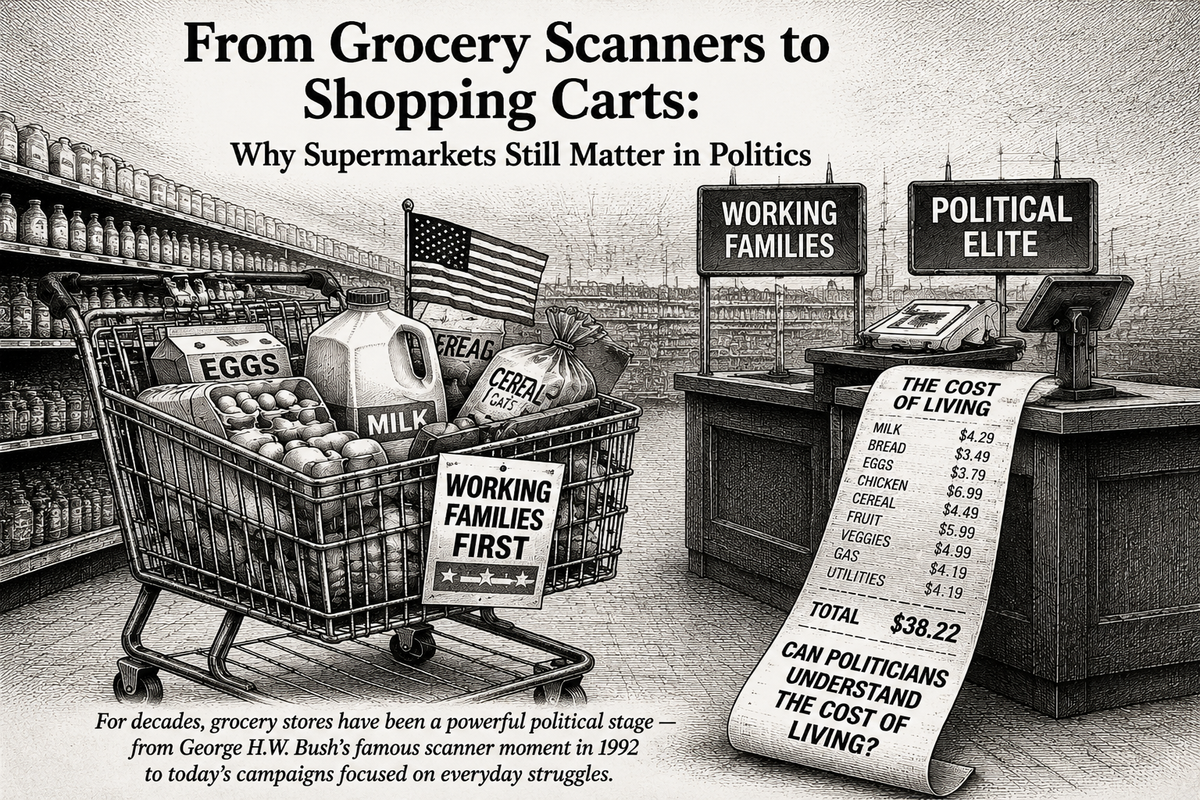
The first image was of Bush looking at his watch during one of the debates. The other image, with audio, was of Mr. Bush amazed at the grocery store scanners, which at that point had been around for about a decade.

The looking-at-your-watch image created the impression that the president, at a minimum, was inattentive and perhaps bored with the whole affair. In fairness, we have all been in the situation where you look at your watch, or nowadays, your mobile device, as an exasperation as your brother-in-law rambles on with a story that somehow started with a fishing trip and has now reached a discussion about his neighbor's lawn mower.

But to do it on the presidential debate stage took that look of boredom to another level. The debate moderator might as well have announced, "The president would like everyone to know he has somewhere else he'd rather be."

The scanner photo op for the president was more damaging. He inadvertently told voters he had not been in a grocery store for years.

The problem was not that Bush did not understand grocery scanners. The problem was the symbolism.

Voters did not see a president being impressed by technology; they saw a wealthy, powerful person discovering something millions of Americans encountered every week.

If he doesn't go shopping or is even aware of what was going on at a grocery store checkout stand, how can he possibly relate to the struggles of everyday people? Fair or not, it reinforced an image of Bush's insider status and raised the question, How can he possibly know our struggles?

Even though the particular scanner was cutting edge, the damage as done. It was an albatross on the president's neck.

Politics has always been a game of perception. A politician can have a thousand policy papers explaining why they understand ordinary Americans, but one awkward moment in a grocery store can sometimes overpower an entire communications department. Nothing says "I'm just like you" quite like a candidate standing next to a shopping cart looking as though they have discovered fire.

During her so-far successful campaign against Rep. Doris Matsui for California's 7th Congressional District, Mai Vang has effectively used social media to convey her message that she is the candidate of the people, and Matsui is for the elite.

A perfect example is the video (see below) in which Ms. Vang, a wife and mother of young children, is grocery shopping. During her talk while selecting groceries, Vang notes Matsui's millionaire status.

Here are portions of the video transcript:

Big money just entered our race for Congress. Doris Matsui, who somehow became a multi-millionaire during her time in office, just loaned
herself $1.4 million to boost her own campaign. Meanwhile, instead of passing the torch to the next generation of leaders, her wealthy donors are now boosting MAGA Republicans.
Yeah, you read that right. They're the same donors. As usual, working families get left behind while wealthy politicians just look out for themselves. Nothing about this changes who we are or what we fight for. Let's do this one...This race is about all of us. What are we going to do to make life more affordable for working families that are living paycheck to paycheck? Ultimately, this is about who you trust to fight for our working families.

As the campaign progresses, especially after Labor Day, we expect to see more videos of this type highlighting cost-of-living issues. Furthermore, we expect Vang's "Doris Matsui, who somehow became a multi-millionaire during her time in office" message will be incorporated into campaign messaging.

The strategy is simple: Put the candidate in a familiar setting, add a shopping cart, throw in a few prices on grocery shelves, and let voters make the emotional connection. In modern politics, a candidate holding a carton of eggs can sometimes communicate more effectively than a 30-page policy proposal.

A campaign consultant somewhere is probably already developing a "walking through the cereal aisle while discussing inflation" package.

How will Matsui address the two-headed hydra of her millionaire status and her relatability to the woes of working mothers out shopping for groceries?

The challenge is not necessarily explaining financial success. Many voters understand that members of Congress can accumulate wealth over decades. The challenge is convincing voters that someone with financial security still understands the anxiety of watching the grocery bill climb higher every month.

Will Matsui take a trip to the area's most expensive grocery store like Nugget Market? Or will she go to WinCo and schmooze with SNAP beneficiaries and WIC-recipient mothers or even working folk just looking to stretch their household budget?

Either choice comes with political risks. At Nugget, critics might say she is shopping where the organic strawberries come with their own financial adviser. At WinCo, critics might wonder whether the appearance is genuine or simply another campaign stop where the shopping cart has been staged more carefully than a Hollywood movie set.

If she does go to someplace like WinCo, which we doubt she has ever visited, let alone knows of its existence, her advance people, who probably haven't been there either, better explain to the Congresswoman that the customer has to bag their own groceries!

Because nothing could turn a relatability photo opportunity into a political disaster faster than a candidate standing at the checkout line waiting for someone else to do the one job every other shopper knows is part of the deal.

The grocery store has become the newest battleground in American politics. Forget television studios and debate stages. The next great political test may be whether a candidate can find the cereal aisle, compare prices, and survive the checkout line without looking like they just landed from another planet.