Klamath Tribes Document First Salmon Hatch in Upper Klamath Lake Tributaries in 100 Years!
This historic event was recorded by the Klamath Tribes' Ambodat Department on March 18, 2026
Hey, it’s been a long week. Record heat spurred by fossil fuel emissions is burning up the nation, President Trump has sent ground troops to the Persian Gulf to devastate Iran and ICE’s reign of terror continues. And the terrible truth about Cesar Chavez, who I worked with from 1973 to 1978, has finally been exposed by women who had the courage to reveal that they were abused and raped by him.
But we have some hopeful news amidst all of the terrible news.
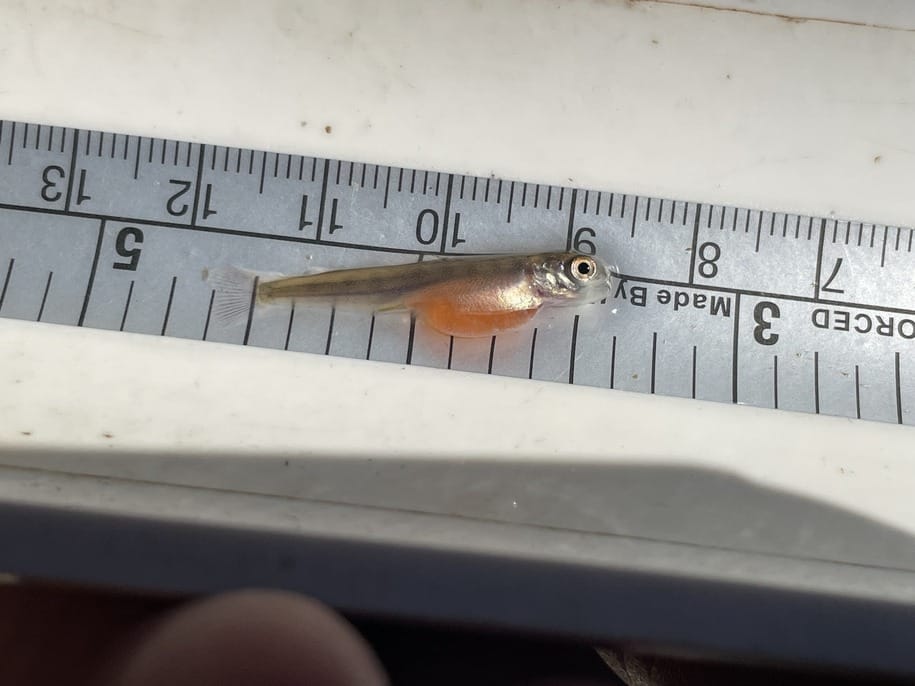
The Klamath Tribes' Ambodat Department (Fisheries Department, meaning “from the water”) Thursday announced the first documented observation of naturally reproduced c’iyaal’s (Chinook salmon) in tributaries of Upper Klamath Lake in over a century!
This historic event, recorded by the Klamath Tribes' Ambodat Department on March 18, 2026, is a major milestone in post-dam-removal restoration and monitoring efforts in the Upper Klamath Basin, according to a statement from the Tribe.
“I see this as the Creator's will of the unwritten natural laws which are allowed to be part of us again,” said Chairman William E. Ray Jr.
Ray’s observation builds on the momentum from 2025, when the first adult Chinook salmon were documented in the Williamson River following the removal of four of the six Klamath River dams. The Tribe further revealed:
“Together, these milestones represent important biological indicators that Chinook salmon are returning to and successfully utilizing Upper Basin habitats. This was no small thing. Chinook salmon have been blocked from their spawning grounds for over a century. They have survived against every odd, pressed against every barrier, and are now, at last, breaking through.
“The observation was made using two rotary screw traps installed by the Ambodat Department, one in the Sprague River and one in the Williamson River. These traps are designed to safely capture downstream-migrating fish, allowing biologists to monitor fish presence, timing, and development without causing harm.
“Rotary screw traps function by using the river’s current to turn a cone-shaped drum that gently guides fish into a live collection box. This method provides a reliable and non-lethal way to sample fish populations, particularly for early life stages that are otherwise difficult to detect in large, complex river systems. Data collected from these traps helps inform fisheries management, restoration success, and long-term monitoring efforts.”
“The detection of hatched Chinook salmon in these tributaries represents a meaningful step toward re-establishing self-sustaining populations in the Upper Klamath Basin. For decades, access to historic habitat has been limited, and these observations signal encouraging progress.
“The Klamath Tribes will continue operating the screw traps throughout the season to track outmigration timing, abundance, and overall juvenile fish health. Ongoing monitoring will help determine the extent of spawning success and guide future management decisions.
“The c’iyaal’s are showing us the way forward. They have returned to a place that was taken from them. In this, they are not so different from the Klamath Tribes. The survival of these fish, along with c’waam and koptu, was promised to the Klamath Tribes in the Treaty of 1864.
“We continue to fight for this land and the revival of all treaty-guaranteed resources promised to us through the Treaty and the United States Constitution Article VI, Clause 2. This milestone signifies another step toward restoring a sustainable fishery in the Upper Klamath Basin and reconnecting Klamath Tribes members with an essential source of medicinal and cultural resources, and subsistence to feed the people. The c’iyaal’s survival is not just an environmental story. It is a continuation of our own.”
To join the Klamath Tribes in this struggle, please consider donating to Seeding Justice’s The Ambo Fund, Water for the Klamath, which goes directly to supporting the Klamath Tribes' treaty-protected fisheries.
Kudos go to the Klamath Tribes, as well as to the Yurok, Karuk, Hoopa Valley and other Tribes and their environmental and fishing group allies for persevering in their campaign to bring the four Pacificorp dams down on the Klamath. I am proud to have been the only journalist to cover this epic story from beginning to end.