In the California Governor's race, undecided voters are not just a side note - they are the story
Late-breaking undecided voters could determine not only who advances out of the primary, but ultimately who becomes California's next governor.
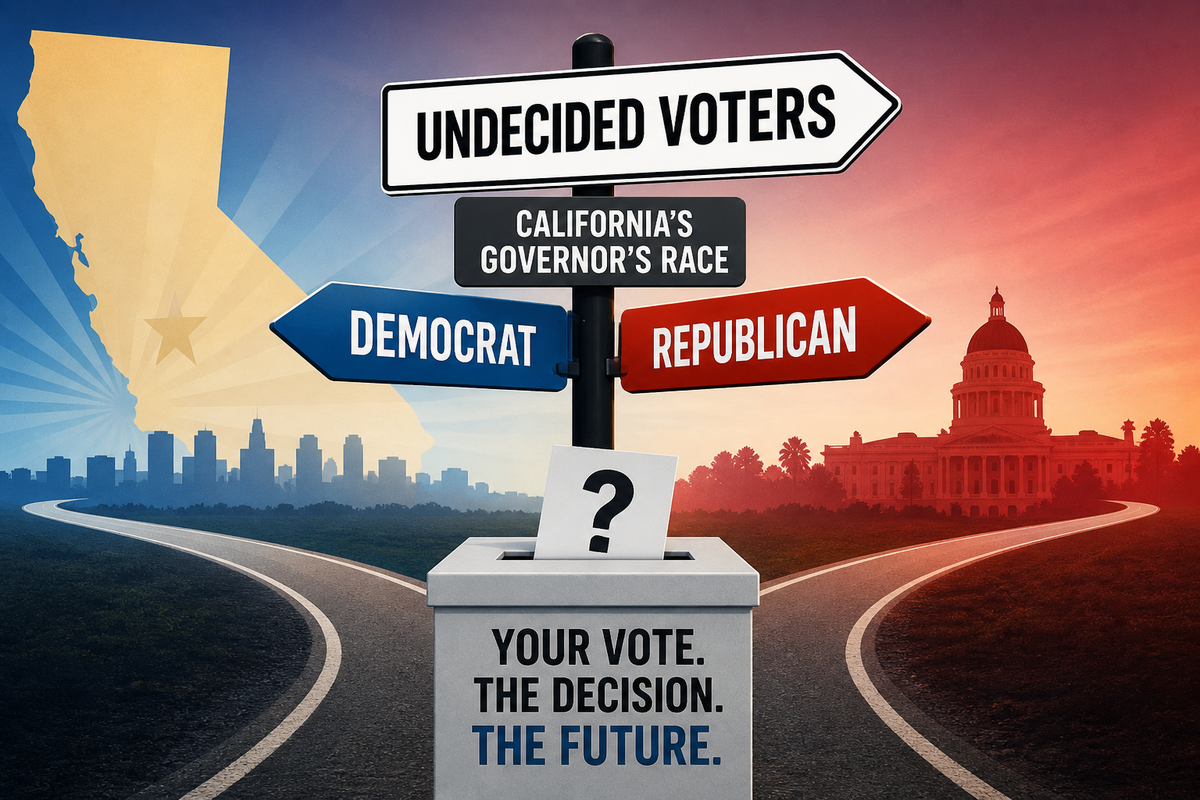
To call the 2026 California governor’s primary uninspiring, even by primary standards, is an understatement. With just over a month before voting ends on June 2 and ballots expected to start arriving in mailboxes next week, there are no clear frontrunners and little momentum behind any candidate.
Even the few developments that might have shifted the race have had a limited effect. Former Congressman Eric Swalwell’s exit following a sexual harassment allegation and Donald Trump’s puzzling endorsement of Steve Hilton, seen by some as undercutting Republican Chad Bianco, have done little to clarify the field.
On the Democratic side, presumed frontrunner Tom Steyer has poured tens of millions of his own money into the race, blanketing airwaves with ads. Yet the spending hasn’t translated into a decisive lead, and there’s little evidence his campaign is breaking through to voters beyond where they have stood for the last several weeks.
Republicans, meanwhile, appear to be consolidating around Hilton. In a telling anecdote, even Democratic households are receiving multiple mailers from both Steyer and Hilton—suggesting campaigns are casting wide nets in a race with few firm loyalties.
Polling and prediction markets loosely point to Steyer and Hilton as the most likely to advance, with Xavier Becerra also in contention, having absorbed some of Swalwell's supporters. But those indicators reflect a fluid race, not a settled one.
From a personal perspective, this primary lesson has provided a teachable moment involving undecided voters. As an American who has been voting for 50 years, I have never understood how regular voters can be undecided in races of consequence, such as the presidency or governorship, even as election day approaches, especially in this era of mass communication and candidate advertising.
Never have I participated in a consequential election in which I remained undecided for so long. But now, as the decision of who to vote for lingers, and I suspect it will not be resolved until the day I vote, which, in California's system, is one day before voting closes.
Now I have a better understanding of the dynamics of an undecided voter. In this election, for me, and in other elections for other voters, it comes down to the field of candidates.
In a crowded, low-energy field with no dominant narrative, undecided voters are not just a side note, they are the story. Their late-breaking choices could determine not only who advances out of the primary, but ultimately who becomes California's next governor.