EGUSD trustee candidates hold postcard party, but will the cards sway voters?
Have these postcards become another piece of political mail wearing a cardigan?
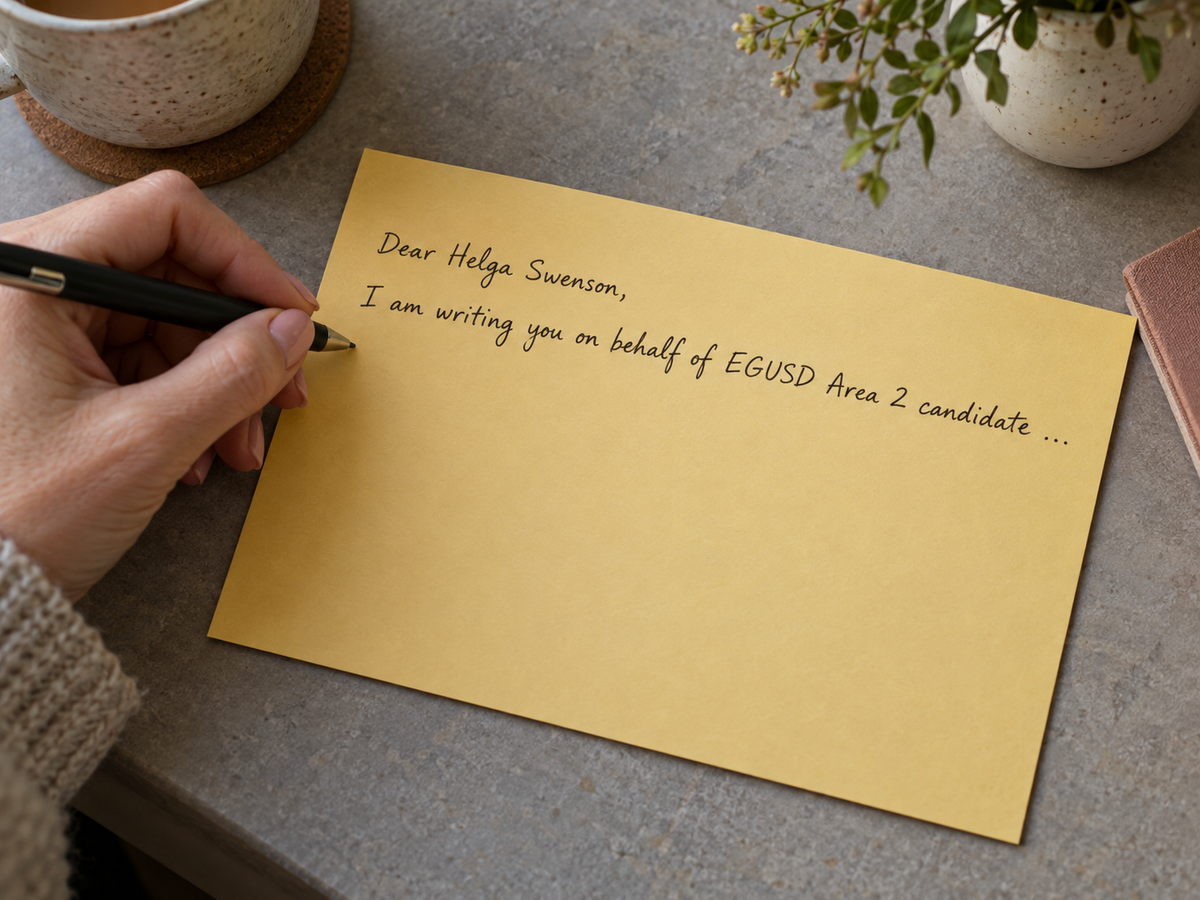
Three Elk Grove Unified School District trustee campaigns are joining forces for a postcard-writing party Monday, Sept. 28. The invitation features Michael Vargas, Delia Baulwin and Varinder Singh, candidates in three separate trustee races, and promises two hours of penmanship at an Elk Grove coffeehouse.
story continued below

It sounds pleasant. It also raises a campaign question: In a mailbox already acquainted with candidate portraits and urgent appeals, does a handwritten postcard still feel personal?
Or has it become political mail wearing a cardigan?
The appeal is easy to understand. A volunteer writes a voter’s name, adds a few words and signs the card. Compared with a glossy flyer addressed to Current Resident, it suggests that a human being spent time on the recipient.
For local candidates trying to introduce themselves, that is an attractive proposition. Jaclyn Moreno successfully used this technique with Elk Grove voters when she won her seat on the Cosumnes Community Services District Board of Directors.
The evidence, however, gives the postcard a more modest job description than its fans might like.
In two randomized tests during the 2018 election, handwritten get-out-the-vote postcards sent to voters in Pennsylvania and Michigan produced no statistically significant increase in turnout. The researchers cautioned that the effects might have been too small for their tests to detect.
In other words, the cards did not prove ineffective; they failed to prove effective.
A 2022 Arizona experiment compared fully handwritten cards with partly handwritten ones. Neither produced a statistically significant turnout gain.
The fully handwritten version performed somewhat better, but the researchers warned against drawing broad conclusions from the result. The campaign equivalent of writing “Dear voter” in especially careful cursive remains unproven.
Postcard writers did get a more encouraging result in a 2023 Ohio special-election test. Among the voters targeted, handwritten cards were associated with roughly a 1.2 percentage-point increase in the likelihood of voting.
The result cleared a 90% confidence threshold, though not the more commonly used 95% threshold. That is evidence of a possible small benefit, not a promise that every postcard party can add 1.2 points to its candidates’ totals. swingbluealliance.org
Then came a 2026 study conducted during a contested local election. Its postcard mailers produced no statistically significant turnout effect, regardless of their message. That finding is particularly relevant to a school board contest, though the study did not test the Vargas, Baulwin or Singh campaigns.
Another limit is worth keeping in view: These studies primarily ask whether people voted.
They do not establish whether recipients voted for the candidate whose campaign sent the card. A postcard could help a voter remember an election without settling a choice between two trustee candidates.
That does not make Monday’s gathering pointless. It brings supporters together, gives volunteers a task and puts the candidates’ names before voters.
A short, sincere note from someone the recipient knows may carry more weight than a stock message copied dozens of times. But the party’s cheerful photos and its eventual stack of stamped cards will be easier to count than any votes the cards produce.
For Vargas, Baulwinn and Singh, the strongest use of a postcard may be as a follow-up: Thank you for telling me what concerns you about your school. That sentence means more after an actual conversation.
In low-information races such as school board elections, the most effective interaction between candidates and voters is face-to-face contact.