EGUSD Area 5 analysis: Democratic split could give Republican Trukhan an opening
See recent social media messages from Reinwald and Trukhan
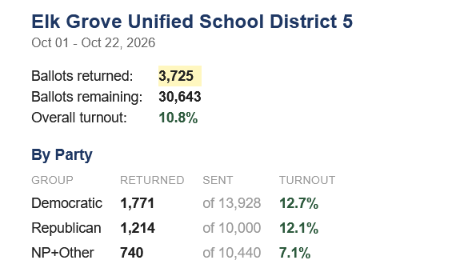
Early ballot returns in Elk Grove Unified School District’s Area 5 illustrate how a Republican could win an officially nonpartisan school board seat despite Democrats holding a registration advantage.
The three candidates have identified their political affiliations: Varinder Singh and Rachelle Reinwald are Democrats, while Elena Trukhan is a Republican. If voters largely follow party lines, the two Democrats could split their party’s support, giving Trukhan a chance to win with a plurality.
continued below

Through Oct. 22, Political Data Inc.’s early vote tracker reported 3,725 ballots returned by voters within Area 5, or 10.8% of the 34,368 ballots sent. Registered Democrats returned 1,771 ballots, Republicans returned 1,214, and voters classified as no party preference or other parties returned 740.
Those figures describe who has returned a ballot within this specific geographic area. They do not reveal votes for any candidate or show that everyone who returned a ballot made a selection in the trustee contest.
Still, the arithmetic shows the potential significance of a divided Democratic vote.
If the 1,771 Democratic voters split their support 60-40 between Singh and Reinwald, the resulting totals would be approximately 1,063 votes for one and 708 for the other. Under a scenario in which all 1,214 Republican voters supported Trukhan, she would finish ahead of either Democrat before accounting for voters outside the two major parties.
That calculation illustrates a possible outcome, not a prediction. Party registration does not guarantee candidate preference, and crossover voting could shift the balance either way.
The contest resembles the district’s three-way Area 7 election in 2024, when Republican Heidi Moore prevailed over Democrats Rehana Rehman and incumbent Carmine Forcina. Moore won with 44.16% of the vote, showing that a candidate can win a seat without a majority when two opponents split the remaining votes.
In Area 5, voters registered without a party preference could play a decisive role. PDI combines those voters with members of other third parties, making it impossible to isolate independent voters in the report. Together, however, those groups account for nearly one-fifth of ballots returned.
Their participation also has room to grow. The combined group’s ballot return rate was 7.1%, compared with 12.7% for Democrats and 12.1% for Republicans. Later returns could substantially alter the electorate’s composition.
Another uncertainty is how many voters will complete the school board contest. Some may vote in higher-profile races while leaving this down-ballot position blank. Those undervotes would reduce the number of votes deciding the seat, and the return tracker cannot show which registration groups might skip the contest.
With nearly nine in 10 ballots still outstanding in the tracker, any of the three candidates could win. But if Trukhan consolidates Republican and conservative support and attracts enough independent voters, her relatively low-profile campaign could secure the seat while Singh and Reinwald, who have campaigned more visibly, divide Democratic support.
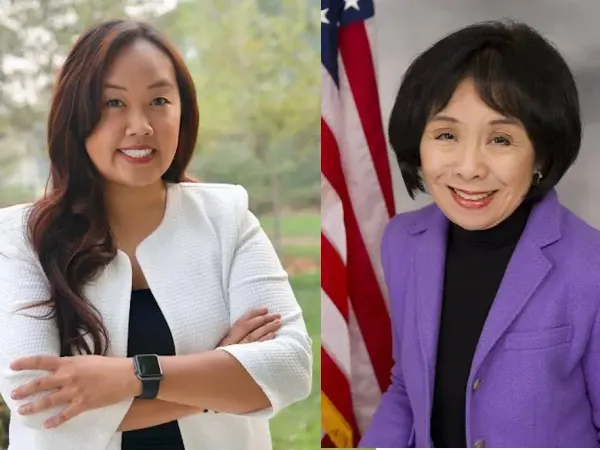
Reinwald
Trukhan