California Water Board issues draft water decision for widely-opposed Sites Reservoir Project
Promoted by the Newsom administration as a response to climate change, the group said the reservoir’s operation would be based on flow rules for the Sacramento River.
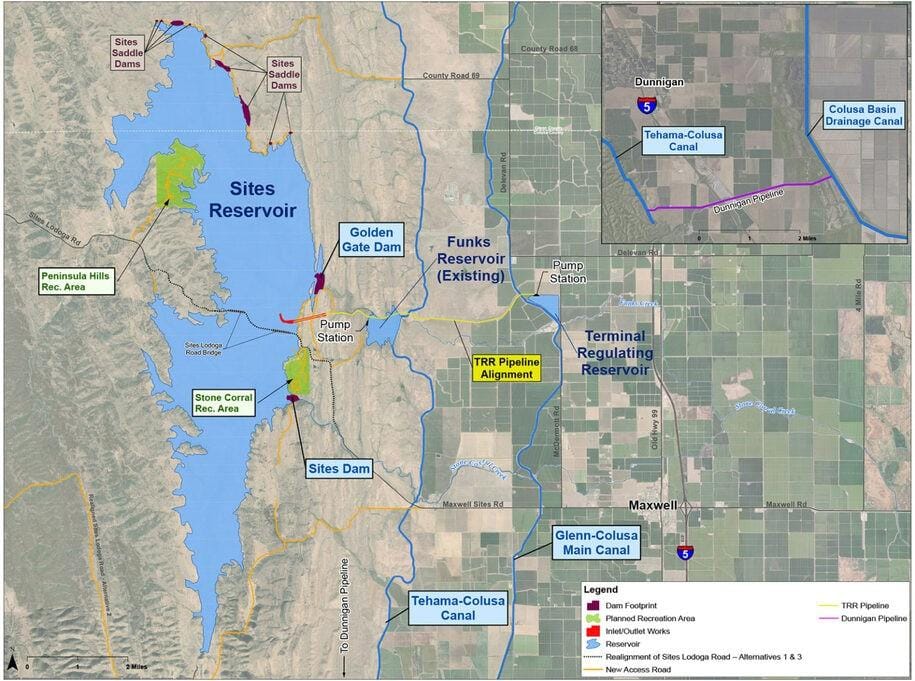
SACRAMENTO, CA – While California Governor Gavin Newsom and President Donald Trump disagree on a number of issues, one project that they both strongly support is the controversial plan to build Sites Reservoir in the rolling foothills of the west side of the Sacramento Valley — at the behest of Big Money interests.
The Administrative Hearing Office of the State Water Resources Control Board last Friday issued a draft water rights decision for the proposed Sites Reservoir project, despite longstanding concerns by Tribes, fishing groups and environmental organizations about the project’s environmental impacts, high costs, and limited benefits.
“The hearing process involved 21 parties, 60 witnesses, 2,115 evidentiary documents and took place over 32 separate hearing days, with a two-day site visit,” the State Water Resources Control Board wrote in a statement. “The draft decision evaluates the evidence and legal arguments received during the proceedings and provides the rationale for conditions contained in the draft water right permit; it is the product of extensive deliberations by the board members during closed sessions over the last two years.”
In drafting the Sites decision, the State Water Board claims it “considered multiple competing needs and set draft conditions to protect senior right holders, water quality, and flows for fisheries in the Sacramento River and Sacramento/San Joaquin Delta.”
The conditions proposed in the draft include the following:
- Annual diversions limited to 986,000 acre-feet of water (That’s roughly the equivalent of two Folsom Lakes).
- Requirements to align the proposed water right with the planning processes underway for the Bay-Delta watershed.
- Operating criteria at the diversion facilities to “protect fisheries.”
However, public trust water advocates disagreed with the glowing assessment of the draft decision by the Water Board.
The California Water Impact Network (C-WIN) said the Board’s draft decision allows the Newsom administration to “formalize strategies for diverting water from the Sacramento River for the project,” including the core of the project: a 1.5 million acre-foot ‘offsite’ reservoir in Colusa and Glenn counties. The reservoir’s current construction cost estimate is between $6.2 and $6.8 billion, according to the Sites Project Authority: sitesproject.org/...
Promoted by the Newsom administration as a response to climate change, the group said the reservoir’s operation would be based on flow rules for the Sacramento River. They pointed out that the Board’s draft decision would impose operating conditions designed to maintain water quality, which would drive up the cost of any water delivered to downstream customers.
“While the Board should have rejected the permit, the proposed operating conditions demonstrate why building another surface water reservoir is a foolish pursuit,” revealed Max Gomberg, Senior Policy Analyst for the California Water Impact Network. “There is no business case for storing water for delivery to big water contractors on a river system that is already oversubscribed and needs more flow to sustain fish populations."
Several tribes, including the Winnemem Wintu Tribe and the Shingle Springs Band of Miwok Indians, have opposed the Sites project. The draft decision does little to address their objections. “The Board should be prioritizing tribal water rights, consistent with its racial equity commitments,” said Gomberg.
In January, Caleen Sisk, Chief of the Winnemem Wintu Tribe, noted that the Sites project will pump Sacramento River water to store in Sites in the “heat of the valley.”
“So essentially they will take good cold water to Sites where it will become warm standing water to then be leased for drinking and for salmon. That is a recipe for water bacteria and parasites for all water users below Sites water releases,” Sisk stated.
Friends of the River (FOR) also criticized the board’s draft decision on Sites, noting that the reservoir would inundate thousands of acres of habitat and reduce flows that are critical to salmon and other species and critical to maintaining water quality downstream.
“In addition, it will produce relatively small amounts of water at high cost. The draft order includes a number of proposed permit terms to prevent or offset the project’s impacts on water quality, fisheries, and Tribal resources – impacts that Friends of the River and allied groups argued were far from fully accounted for,” the group argued.
“The draft water right decision clearly shows that the Board agrees with our position that the proposed reservoir will cause major water quality and environmental impacts that need to be addressed,” said Keiko Mertz, Policy Director at Friends of the River. “We appreciate that the Board adopted some of our recommended safeguards, but important gaps in protection remain for some of the state’s most valuable resources.”
“Sites water was already unaffordable—this reinforces that the project is a boondoggle that will worsen, not solve, California’s water affordability challenges,” she observed.
Friends of the River said it plans to work with its allies to “prepare extensive comments identifying what is still needed to fully protect fish, water quality, and public trust resources.”
As the State Water Board considers final action, the organization urges decision-makers to “carefully weigh whether investing billions in an increasingly costly and environmentally harmful project is a responsible path forward for California’s water future, when more economically efficient, climate resilient, and environmentally friendly alternatives are available.”
A sixty-day public comment period is now in effect, with comments accepted until May 22. Following consideration of the comments, the draft will be reviewed by the Board’s Administrative Hearings Office for possible revision and submission to the Board. A second comment period will follow prior to a final decision.
More information on the Sites water right application can be found on the board website.
In January, the U.S. Department of the Interior approved the Record of Decision, or ROD, for the Sites Project. The ROD authorizes the Bureau of Reclamation to provide up to 25% of the total cost for the 1.5 million acre-foot off-stream reservoir.
“President Trump made clear that federal water projects must deliver real results for American families,” Secretary of the Interior Doug Burgum said in a statement. “This administration is getting it done in record time. The Sites Reservoir Project and the gains achieved over the past year demonstrate how a disciplined, mission-focused approach can expand water reliability for communities, agriculture and the economy.”
The approval of the state’s draft water rights decision for Sites and the federal ROD come at a time when the Sacramento-San Joaquin River Delta ecosystem is in its worst-ever crisis, as disclosed in a January 6 memo from Margaret Johnson, Environmental Scientist Bay Delta Region, to Erin Chappell, CDFW Regional Manager: nrm.dfg.ca.gov/…
The report reveals that zero Delta Smelt (Hypomesus transpacificus) were detected during the CDFW fall midwater trawl survey in the Bay-Delta Estuary for the eighth year in a row. Not only that, but other fish species, including Longfin Smelt, Sacramento Splittail, Striped Bass and Threadfin Shad continued their dramatic decline from 1967 when the State Water Project went into effect.
Once the most abundant fish in the entire Delta, the smelt is an indicator species found only in the Delta. Its decline to virtual extinction in the wild is a symptom of a larger decline, the Pelagic Organism Decline (POD), of the once robust open water fish populations of the San Francisco Bay-Delta Estuary.
Likewise, Sacramento River Fall Chinook Salmon populations have just begun to recover from three years of dramatically low returns of adult fish to the river and its tributaries, resulting in the total closure of commercial ocean salmon fishing for an unprecedented three years in a row.