Breaking: No Delta Smelt Found in Fall Midwater Trawl for Eighth Year in a Row
The collapse of the Delta fish and salmon populations has been caused by the export of vast quantities of water to corporate agribusiness interests
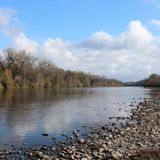
For the eighth year in a row, the California Department of Fish and Wildlife has found zero Delta Smelt in their annual Fall Midwater Trawl survey in the Sacramento San Joaquin Delta in September, October and November of 2025. The results for December haven’t been compiled yet.
The smelt, once the most abundant fish in the entire Delta, is an indicator species found only in the Delta. Its decline to virtual extinction in the wild is a symptom of a larger decline, the Pelagic Organism Decline (POD), of the once robust open water fish populations of the San Francisco Bay-Delta Estuary.
The smelt has been demonized as a “worthless minnow” by President Trump and corporate agribusiness interests in the San Joaquin Valley, while Tribes, environmentalist groups and fishing groups point to the key role that it plays in the ecology of the Bay-Delta Estuary: https://sacramento.newsreview.com/2025/01/13/falsely-blaming-the-la-wildfires-on-delta-protection-and-imperiled-smelt-is-creating-a-distortion-of-california-water/
The species has been kept from total extinction by a captive breeding program run by UC Davis in Byron in the Delta. In a cooperative project, the state and federal governments have released thousands of hatchery Delta Smelt back into the estuary.
The latest survey results are revealed in a just released December 22 memo from Margaret Johnson, Environmental Scientist Bay Delta Region, to Erin Chappell, CDFW Regional Manager: nrm.dfg.ca.gov/...
The monthly FMWT surveys were conducted Sept. 2-17, Oct. 1-16, and Nov. 3-18. During each of the three months, 130 fish trawls were conducted, except for one station in October, Johnson reported.
“No Delta Smelt were collected at any stations from September through November,” Johnson wrote. “The 2025 September-November index (0) is tied with 2016 and 2018-2024 as the lowest index in FMWT history.”
However, she pointed out that the Enhanced Delta Smelt Monitoring (EDSM) survey of the U.S. Fish and Wildlife Service (USFWS) did find 31 Delta Smelt between October 6 and November 20, a period of seven weeks which comprised of 906 tows (U.S. Fish and Wildlife Service 2025).
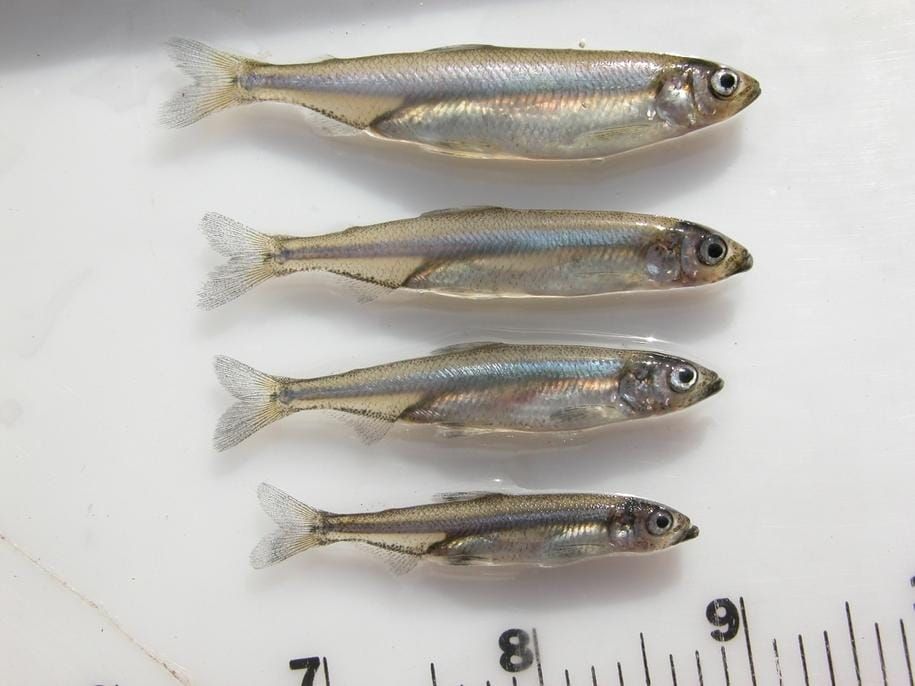
Most adult Delta Smelt are less than 3 inches long . They are nearly translucent, with a steely-blue sheen on their sides. They usually live for just one year, spending their entire lives in the San Francisco Bay-Delta. They have a smell that is similar to that of cucumbers.
“As larvae, they start out eating microscopic food like unicellular algae, planktonic animals, and small crustaceans. As they grow, their diet shifts almost exclusively to small crustaceans called copepods,” according to the Center for Biological Diversity.
The Delta Smelt’s dramatic decline is part of the larger Pelagic Organism Decline (POD) in the San Francisco Bay-Delta Estuary, first identified by state and federal government biologists in 2004. Along with the Delta Smelt, populations of Striped Bass, Longfin Smelt, Sacramento Splittail, Threadfin Shad and American Shad have crashed in the Delta in recent years: www.nceas.ucsb.edu/...
Striped Bass:
Striped Bass, an introduced anadromous fish species that is popular with anglers that reached an estimated high of 3 to 5 million legal-sized fish in the 1960s, continued their precipitous decline.
“Seven age-0 Striped Bass were collected at index stations in September for an index of 6. In October, five were collected for an index of 5. In November 18 were collected for an index of 18. The 2025 September-November index (29) is a 68% decrease from the previous year,” Johnson wrote.
Longfin Smelt
The Longfin Smelt, a native fish species that is now a candidate for listing under the federal Endangered Species Act, showed a relatively small increase from the previous year’s survey, but the population is still at just a small fraction of historical levels.
“Zero Longfin Smelt were collected at index stations in September, resulting in an index of 0. In October, four were collected for an index of 4. In November, 60 were collected for an index of 133. The 2025 September-November index (137) is an 11% increase from the previous year. One Longfin Smelt was collected at a non-index station during the October survey,” Johnston noted.
Threadfin Shad:
Threadfin Shad, an introduced fish species that was released by the CDFW as a forage fish for larger fish, declined even further from the previous year’s survey.
“One Threadfin Shad was collected at an index station in September for an index of 1. In October, two Threadfin Shad were collected for an index of 2. In November, five were collected for an index of 5. The 2025 September-November index of 8 is a 97% decrease from the previous year. A total of 915 Threadfin Shad were collected at non-index stations during September, 95 were collected in October, and 125 were collected in November,” Johnson continued.
Sacramento Splittail:
Likewise, Sacramento Splittail, a native minnow that used to support a popular recreational fishery on the Sacramento River during high water years, were completely absent from the fish caught in the survey.
“No Splittail were collected at index or non-index stations in September through November for an index of 0. The 2025 September-November index (0) is a continuation of low to zero catch in recent years,” Johnson said.
She noted that the “Splittail FMWT index tends to be low or zero except in relatively wet years, such as 2011.”
American Shad:
The American Shad, an introduced anadromous gamefish, has not collapsed as precipitously as the other fish species, but they still are found below the historical numbers that once thrived in the Delta.
“A total of 428 American Shad were collected at index stations in September for an index of 477. In October, 105 were collected for an index of 170. In November, 201 were collected for an index of 233. The 2025 September-November index (880) is a 8% increase from the previous year. 148 American Shad were collected at non- index stations during September, 67 were collected in October, and 55 were collected in November,” she wrote.
I encourage anybody interested in the collapse of once abundant fish species to read the entire memo and look at the graphs: nrm.dfg.ca.gov/…
The collapse of the Delta fish and salmon populations has been caused by the export of vast quantities of water to corporate agribusiness interests in the San Joaquin Valley and Southern California water agencies by the State Water Project and Federal Central Valley Project for many decades. Other factors behind the collapse include toxics, pollution, increased water temperatures and invasive species.
Between 1967 and 2020, the state’s Fall Midwater Trawl abundance indices for striped bass, Delta smelt, longfin smelt, American shad, splittail and threadfin shad have declined by 99.7%, 100%, 99.96%, 67.9%, 100%, and 95%, respectively, according to the California Sportfishing Protection Alliance.
Background on Delta Smelt, courtesy of Center for Biological Diversity:
Delta smelt happen to be one of the best indicators of environmental conditions in the San Francisco Bay-Delta. This ecologically important estuary is a major hub for California's water system — and an ecosystem that’s now rapidly unraveling. The “smeltdown in the Delta,” as the extinction trajectory of delta smelt is known, has left the once-abundant species in critical condition due to record-high water diversions, increasing water temperature, pollutants, and harmful nonnative species that thrive in the degraded Delta habitat.
This smelt's catastrophic decline is a warning that we may lose other native Delta fish species that have also fallen to alarmingly low levels — including longfin smelt, numerous Central Valley runs of salmon and steelhead, and green and white sturgeon. In fact more than a dozen of the original 29 indigenous Delta fish species have either been eliminated entirely from the estuary or are threatened with extinction.
An analysis in 2006 warned that the delta smelt could go extinct within 20 years, and since then numbers of smelt found during state surveys have been too few to even calculate abundance. From 2018 to 2023, no delta smelt were found. That’s shocking for a fish that was once common in the upper Sacramento-San Joaquin Estuary. Delta smelt probably now exist in the wild only because of emergency hatchery efforts by the UC Davis Fish Conservation and Culture Laboratory.
As more information comes in, I will post it here.