As Elk Grove Repurposes Old Library, Extensive Public Input Promised by City

The city plans to use a more collaborative approach to the future use of the structure.

As Elk Grove Repurposes Old Library, Extensive Public Input Promised by City
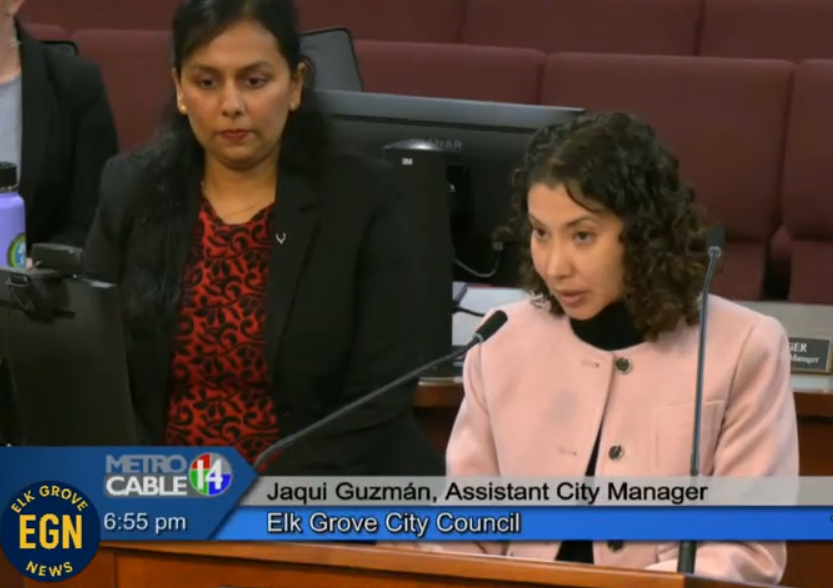
Elk Grove Assistant City Manager Jaqui Guzmán speaking to the Elk Grove City Council.

During last night's meeting, the Elk Grove City Council heard a presentation on the future of the city's former library building on Elk Grove Boulevard and Elk Grove-Florin Road, once the new library on Elk Grove Boulevard and Waterman Road opens in mid-2026.

Calling the effort for extensive public input a "unique opportunity" to let residents help design how the high-visibility site will be reused once the library relocates, Assistant City Manager Jaqui Guzmán, joined by Senior Management Analyst Aishwarya Kumar, delivered an overview of the Old Library Site Reuse Project.

The two-story, 13,875-square-foot building will be vacated when the new library opens in the summer of 2026, according to a staff report.

Guzmán told the council the project represents "a really unique opportunity" not only because of the site's prominence as a gateway to Historic Main Street, but also because the city plans to use a more collaborative approach.

"We hope this will allow us to co-create with our residents to ensure that the final solution enriches civic life," she said.

Rather than staff developing options and asking residents to react, Guzmán said, "we're going to put our residents at the center, allowing them to generate ideas and to design the future use of the library along with city staff."

Guzmán said co-creation would help the city gain a "deeper understanding of community needs," strengthen trust, and lead to solutions that are "better and more relevant."

Ms. Kumar outlined a three-phase timeline beginning with the current preparation period, which runs through February. Staff will refine project goals, prepare floor plans and visual aids, and develop initial reuse scenarios that can serve as starting points for discussion.

The core of the effort begins in Phase II, a broad community engagement process scheduled for spring and summer 2026. Workshops at the library site, pop-up events, surveys, and online idea-generation activities will invite residents to "ideate, prioritize, and evaluate" potential concepts, Kumar said.

Phase III, expected to begin in fall 2026, will involve refining the top options, producing preliminary cost and feasibility analyses, and ultimately returning to the council with recommended paths forward. Staff could return to the public for additional feedback if needed.

Kumar also noted several fixed constraints: the existing building footprint, the number of parking spaces, the community commercial zoning, and the façade and building height must all be preserved.

Council members expressed broad support for the engagement plan, praising its emphasis on early and inclusive community involvement.

"I would love to have the opportunity for residents to weigh in early, and I definitely support the approach," Councilmember Rod Brewer said.

Mayor Bobbie Singh-Allen asked whether the process would consider options beyond city reuse, including the possibility of selling the property if residents suggested it.

"Are we prepared to have that kind of information available, not just for a reuse for our purposes, but perhaps selling it?" she asked.

Ms. Guzmán said certain elements, such as building size and parking, are fixed, but decisions about whether the property must remain a city asset are ultimately up to the council.

"It really is up to you," she said. "It can be as open as possible or have more parameters depending on council's direction."

Ms. Singh-Allen said she was open to determining parameters later, once staff have gathered community input.

Staff will return with a refined framework before the launch of the community co-creation phase in early 2026. Guzmán said the goal is to conduct a soft launch of the engagement effort after the new year.

The current library formally opened on December 6, 2008 (see video below). That facility was plagued by a design that failed to account for the weight of books and other media placed on the second floor.